Left or Right Side? The pathway of works-based performance vs the grace of Spirit-filled identity: An introduction to the “Left side” of the “Conscience Chart”
[Reading Time: 11 minutes]
Introduction
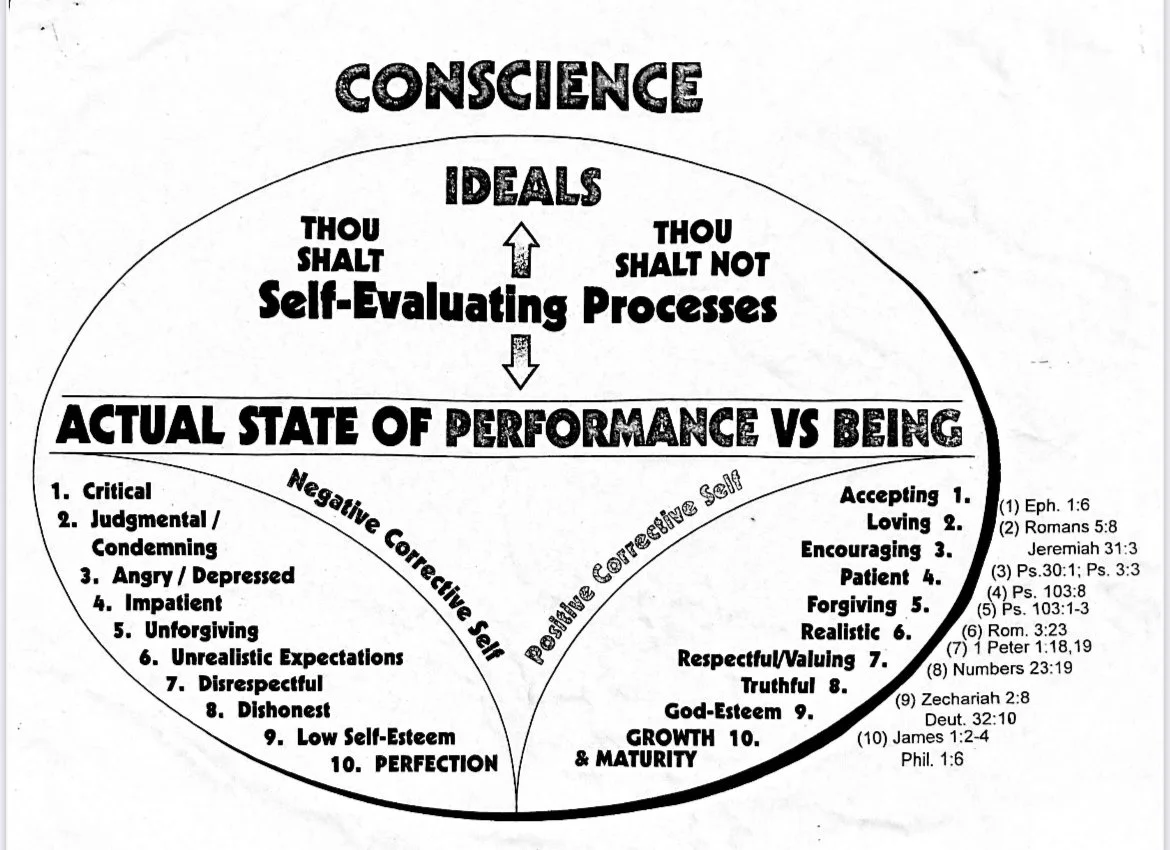
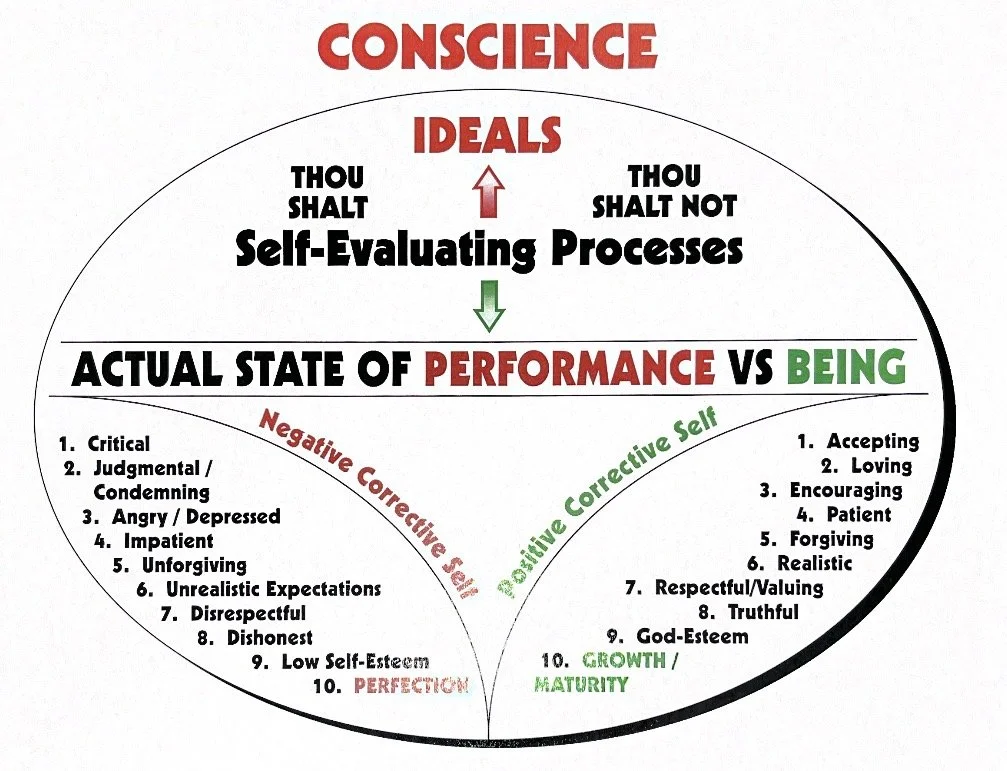
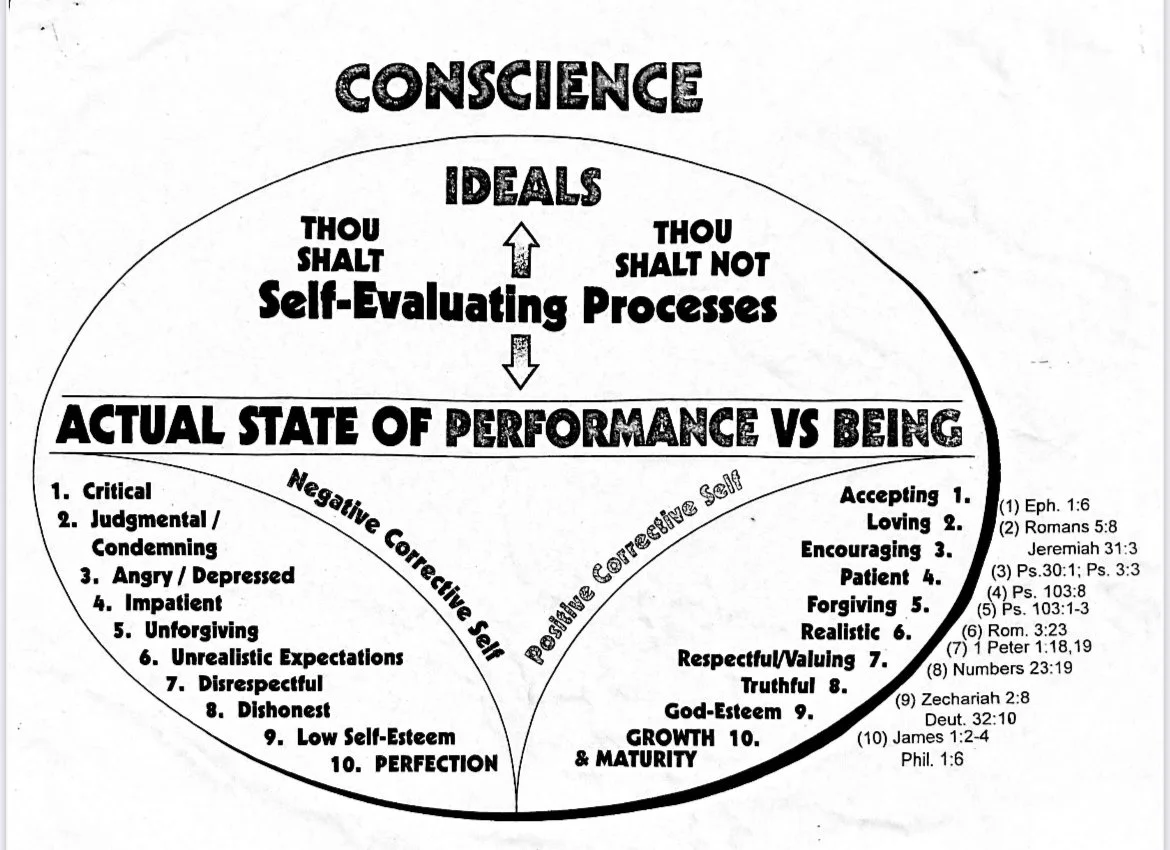
In a prior writing, we introduced what has come to be known as the “Conscience Chart,” a graphic that helps us differentiate in real-time what is actually driving our behavior, providing insight into
Why is it that we do what we do?
Act the way we act?
Respond the way we respond?
The chart offers a list of identifiers that quickly reveal to us whether we are operating on the “left” or the “right side.” That is to say, whether we are living under a works-based system of performance (the “left” side), where we are the subject of every verb, meticulously working, planning, calculating so as to control every outcome. Or whether we are living out of a continual reception of Fourth-dimensional grace (the “right side”), where God is the Subject.
In working through each identifier on the “left” and “right” side, we would do well to think of how we respond—not “in comfortable and easy times in happy hours” (Spurgeon, "The Minister in These Times,” 1886), but
when we’re stressed;
when under pressure;
when overworked;
when in need;
when disoriented and confused.
What attributes do we manifest then?
And even more particularly, not merely in periods of stress and high demands, but
when we actually mess up;
when we make the wrong decision;
when we’re exposed;
when are weaknesses are put on full display—
How do we respond at these points?
But going even deeper and looking at it from one further vantage point, how do we act when we have actually lived faithfully and honestly, but in the process have been
hurt;
lied to;
kept in the dark;
betrayed—
What is our response now?
The Conscience Chart: The “Left Side”—critical
The first attribute we see on the “left side” is
“critical.”
Any problem, if we are manifesting the logic of the “left side,” begins with someone else (“him,” “her,” “them”), be it our family, our spouse, our parents, our parents-in-law, our children, our boss, our co-workers, etc., etc. On the “left side,” we assure ourselves that we are not “the issue.”
Any difficulty and stress in our families, children, marriages, finances, work, churches, communities is invariably caused by the “other.” And so, when I am opening up to you about any issue in my life, I must give you all the details of
“what he/she/they have done.”
Because
“They are the problem.”
And more to the point,
“If they could just change, things would get better.”
But what if the “other” thinks that each we are the problem?
A letter at a family wedding
It’s like a lady telling me of a family wedding where two of her sisters, who had become progressively estranged from each other, both showed up at the ceremony.
The first approached the other and said,
“I am unable to speak with you because it is too unsafe;
But I have a letter for you, written by my therapist.”
Her sister, receiving the letter, then responded by handing her one herself, saying,
“And I have a letter written by my therapist for you.”
They exchanged their therapists’ letter and with nothing further to say, both parted ways.
No words were spoken beyond this. No honesty. No vulnerability. Nothing owned. Nothing admitted. And so…nothing happened…other than both revealing where they were.
They were each locked in the world of the “left side,” convinced that they were right and the other was wrong. And both even provided a document from a paid medical professional who supported their conclusions.
Suffice to say, this was not a pathway of reconciliation…
When we’re in this critical state, we’re not seeking to understand each other so as to share our experience, strength and hope. The critical mindset leads us invariably on to judgment.
The next identifiers—judgmental…angry…depressed
Having begun with criticism, we quickly move into judgment. And so the next identifier after “critical” is “judgmental” and “condemning.”
In refusing to deal with our own issues and constantly projecting all our our own guilt onto another in judgment and condemnation—far from making us feel more secure (as if our guilt can actually be removed by judging another)—it begins to make us “angry” and “depressed,” the next set of attributes.
That is to say, when we fail to deal with our issues and go to the length of projecting all of our problems onto another, we lose the ability to effectively work through our own issues.
And so things get worse.
And we get worse in the process.
And the emotion that then overtakes at this point is anger. Not merely because we can’t seem to get things under control; but moreover, because everything we do to “fix” the problem only seems to make it worse.
A word on anger and what’s underneath
Pilgrim’s Progress, the “left side” and the “Slough of Despond”
Anger is a surrogate emotion (See the chart, Anger Model: Primary feelings of anger explained). Or to put it another way, anger always displays an array of emotions underneath it.
Or more, simply, I am always angry “because” of something.
And identifying what that “because” actually is, then enables us to access the deeper emotions driving our anger…which may be all sorts of thigs:
Fear, disappointment, insecurity, inadequacy,
hurt, slander, rejection…depression.
When we begin to understand why we are actually angry, we can then begin to receive the grace of God that draws us out of the self-focused, emotional bog of the left-side—which John Bunyan referred to as the “Slough of Despondency.”
In the early scenes of Pilgrim’s Progress, Christian sets out on his journey from the “City of Destruction.” And though some of his neighbors “mocked” and “threatened” and “cried after him to return,” one stayed by his side named Pliable, at least initially…
Enthralled by his words on the “endless Kingdom” and “crowns of glory” and garmentsshining “like the sun” (p. 4-5), all of this comes to an immediate end, when Pliable and Christian
“fell suddenly into a bog” whose “name was Despond” (p. 6).
And what happens to them both reveals key insights into the nature of the human struggle.
Two different paths out
Sinking into the mire, Pliable yells out angrily,
“Is this the happiness you have told me all the while of?”
“If we have such ill speed at our first setting out, what may we expect between this and our journey’s end?”
Giving a “desperate struggle,” he then rises out of the bog and immediately abandons Christian. Left by himself, Bunyan writes that Christian, however,
“could not get out
because of the burden that was on his back.”
This is a critically important on two accounts:
First, Pliable can indeed pull himself out of the bog, because he has not yet come to feel the full weight of the burden of his own guilt.
But second, and more significantly, Christian, himself a believer who was only moments earlier confidently speaking of the glories of Heaven’s bliss, cannot.
He is utterly powerless.
And the more he struggles, the deeper he sinks into the Slough.
This is the burden of the left side. And his pathway out will require the help of another.
(Writing in progress)
Receiving
But again, this requires greater levels of self-knowledge and understanding (See the article, Know Yourself that You May Know God). Because without this self-knowledge, we cannot enter into this territory when we are operating on the left-side; when we are trudging through the muck of the bog of despondency.
What is open to us is only evasion and blame-shifting. Yet in doing so, the burdens we are carrying only get heavier.
From the “Slough” of criticism, judgment and anger to progressive impatience;
An image from the Cross
Continuing down this path, we deal with our issues by bearing the heavy weight of continually blaming the other; judging; condemning.
And this makes us more and more impatient.
We are impatient because we cannot look inward in any genuine way, seeing how our actions have contributed to the outcome—even if we have been “righteous” and upright in the ways we handled it.
Could it be that the resistance that we are facing is the precise means to embed the Gospel deeper into our lives and the lives of those around us?
Imagine if Jesus were hanging on the Cross, spewing out criticisms and blame on those who had put Him there.
No. Christ hangs there in silence.
And when He does open His mouth, He speaks in ways
that bring healing to the dying thief (Lk 23:39-43);
that offer care to his soon-to-be-bereaved mother (John 19:26–27);
that commit Himself totally to His Father (Luke 23:46).
The outcome of this pathway is nothing short of transformative—this is key.
In witnessing the suffering of Jesus, even the centurion (whom we assume had nailed Jesus to the Cross), standing beneath its shadow, then declares,
“Certainly this was a righteous Man!” (Lk 23:47)
We may imagine his inner turmoil:
“How is this possible?”
“This man was accused, betrayed and condemned in a riot by His own people. Then beaten within an inch of His life, He carries His own Cross to this hill of shame.
The religious leaders follow Him and do not stop their mocking.
Yet even here, even now, His words are spoken in grace, in purity, in love.
How could this be?”
This is the transformation of the “right side” which not only changes us, but moreover, transforms those around us (More on this in the article on the “Right Side” of the “Conscious Chart”).
Staying here for a moment, however, we turn to a presentation on reconciliation from a pastor caught in the throes of war and murder and betrayal.
From the Cross to war-torn Burundi: The paradoxical power of forgiveness
In the The Fourth Lausanne Congress (Seol 2024) there was a panel presentation in which pastor Manuel Ndikumana from Burundi bore experiential witness to the power of forgiveness. Amidst the generational violence of the Tutsi and Hutu conflicts that left families divided and communities torn apart, and betrayal and to how forgiveness has the paradoxical ability to first “liberate” then actually “profit” the victims of violence. And what is more, once it has liberated the victim, forgiveness works to next free the perpetrator of the crimes
In his words,
“Forgiveness is God’s given means to liberate first the victim, then the perpetrator from the devastating, harmful consequences of violence. That is to say, forgiveness first profits the victims before it profits the perpetrators who are being forgiven.”
Going further, he declares that forgiveness actually
“protects the victims who forgive from being contaminated by the contagion of the inhumane violence.”
This is because
“Violence and injustice cause emotional wounds that, when not healed, infect the victim’s entire being.
In other words, when the emotional wounds are not treated, they cause more harm to the victim.
These are extraordinary statements. The violence inflicted on a person is one layer; but below it lies the deeper layers of emotional wounding. And if those are not treated, they will become “contaminated” and infected in ways that spread the disease deeper.
The opposite pathway (the “right side” we might say) introduces the possibility of healing.
“When, however, the victim freely decides to forgive the perpetrators, the chain of violence is broken and the victim is liberated.
Liberation not only for the victim, but also for the perpetrator.
When the perpetrator, in turn, accepts his responsibility and asks for forgiveness, there is a new beginning.
But what if the consequences of the perpetrator’s actions cannot be reversed? This pastor, to put it in context, had lived through the Tutsi-Hutu civil wars of the 1990’s and 2000’s and had experienced first hand widespread, injustice, betrayal, murder…massacres, reprisals and displacement.
What is the good of forgiveness then? The planting, we might say, of a small seed:
“When the violence the perpetrator committed is irreversible, forgiveness offers a second chance, the possibility to begin again in your relationship.”
And then he declares something absolutely extraordinary:
“Therefore, all is in the hands of the victim because the perpetrator is already imprisoned by the irreversible act which he committed.”
When we are harmed and wounded; when lies and injustice are committed against us, we begin to feel totally powerless. But this is simply not the case. In our “hands” lies everything.
We can choose to lash out and, in so doing, lock ourselves and our families in the cycle of violence generationally
[Note: Burundi’s independence had occurred in 1962; but increasing polarization between the Tutsis, who had been politically elevated by the colonial Belgians over the Hutu and Ganwa clans led to a coup in 1965. That initial coup ultimately failed, yet what followed were the first nationwide waves of ethnically-targeted killings between Hutus and Tutsis. Continuing their rise, the Tutsis consolidated their power politically and militarily, dissobled the monarchy and proclaimed a Tutsi-dominated Republic that withstood local uprisings through the late 1960’s and early 1970’s until
The Final Beatitude: A word of life breaking in to our suffering
That is to say, in the realm of Eternity, our wounds can be the entry point into greater blessing. In the words of Jesus, the final beatitude is this:
“Blessed are those who are persecuted for righteousness’ sake,
For theirs is the kingdom of heaven.
Blessed are you when they revile and persecute you, and say all kinds of evil against you falsely for My sake” (Mt 5:10-11).
When they do this to us, because we are coming to discern the inner workings of the Kingdom of Heaven, we can then
“Rejoice” and be “exceedingly glad”
knowing that
“great is [our] reward in Heaven.”
That is, this final beatitude is given to us precisely
when we are suffering;
when we are rejected;
when we are cast out.
“For so they persecuted the prophets who were before you” (Mt 5:1-12).
We know that Jesus never condoned injustice. He instead confronted it and transformed it. We also know that He never responded to evil with evil or to violence with violence. He willingly chose to love His enemies and to forgive His persecutors…
Our otherness [as citizens of the Kingdom of Heaven] does not allow us to behave in a certain way. This can be seen as betraying our earth citizenship, which may come with a cost. But it is by living as citizens of another country, that we are salt and light in this world. And, in so doing, we bear witness to the world that the blood of our ethnicities and nationalities should not run deeper than the waters of baptism through which we have been made one in Christ.”
From impatience to unforgiveness
But continuing on the left-sided pathway, we do precisely the opposite. Instead of forgiving our accusers, we double down.
We convince ourselves that
“they are wrong;” that “they caused this;” that “they need to be dealt with.”
We conjure all the Bible verses into our armamentarium:
“Do not be deceived, God is not mocked;
For whatever a man sows, that he will also reap” (Gal 6:7).
Clearly, we are not the problem. They planted the seed. Whatever happens is their fault.
They have “plowed iniquity” and “sown trouble”
And now they are reaping the consequences (Job 4:8).
The Spirit of Unforgiveness
Overtaken with criticism of the other in a way that makes us judgmental and condemning of them, our relationships get worse. And the health of our relationships, as we will find, is a metric of whether we are operating on the left or the right side.
On the left, we have convinced ourselves that what to do…when things go wrong…then we have to, of course, keep our our faults and failures and inconsistencies and hypocrisies from coming into view.
And we have to keep engineering a scrupulously curated image to maintain the projection?
But if the projection begins to break down, Or if our past is too much, do we simply deny it?
And if that doesn’t work, then do we just blame?
Our family of origin? Our work situation?
Our church (that’s not a true church)?
Our friends (that aren’t our friends at all)?
Or do we see all of these as opportunities to internalize the reality of the Gospel into new, hitherto untouched layers of our personality?
As opportunities to receive new outpourings of the Spirit’s grace in ways that heal and restore and strengthen us?
And finally,
Do we accept our families of origin? Where we came from?
(If I’m Oedipus, my parents literally tried to kill me and wipe my memory from the face of the earth!)
Or do we feel the compulsion to make a new, nicely packaged one to present to a watching world…which…is most singular in the fact that it’s not our family?
We’ve moved passed that.
We’ve left it in the past.
But have we?
Are we living in a world of “Thou shalt” and “Thou shalt not”
Or is God the subject of each verb?
Which is to say,
Is He the One Who is leading us, directing us, guiding us?
Or is it ourselves?
Is He the One Who accepts us, loves us, forgives us?
Or is all this dependent upon us?
Is He the One Who encourages us, comforts us (confortare), strengthens us, teaches us Truth, opens our eyes to those things that we need to confront?
Or does all this come through our spiritual performance?
Because we prayed enough, fasted enough, repented enough, read enough Scripture, led enough Bible studies, led enough small groups, volunteered enough, gave away enough, did enough short-term missions, etc., etc., etc.?
Is He the One Who knows us and accepts us, values us—eternally—in a way that is not finally dependent on our ever-changing level of performance?
Is He the One Who reacts to our volatility with calmness and patience?
Is He the One Who, when he make mistake after mistake after mistake, responds with infinite mercy and an indelible grace that is inexhaustible?
And with this introduction to the Conscience Chart, we move into an absolutely fascinating Greek tragic drama, Oedipus Rex, which we might have read way back in high school…but which offers us today a living picture of where self-deception can lead us…
Self-knowledge: An ancient philosophical perspective
Offering one final introductory remark, we should remember that the Ancients well understood that true knowledge begins with accurate self-knowledge. To the degree that the words inscribed over the Oracle at Delphi were
“Know Thyself” (gnōthi seauton)
And while the original meaning of the phrase likely communicated the idea of “knowing your limits,” Socrates and his philosophical heirs came to see it in more comprehensive terms.
His student, Xenophon (c. 430–354 BC), presents a conversation between Socrates and a highly educated and ambitious young man (Euthydemus). Seeing his potential yet understanding that his overconfidence could prove disastrous when he enters into the realm of politics, the old philosopher pursues the below line of questioning:

“Then did you notice somewhere on the temple the inscription ‘Know thyself'?”
“I did.”
“And did you pay no heed to the inscription?
Or did you attend to it and try to consider who you were?”
“Indeed I can safely say that I did not; because I felt sure that I knew that already;
for I could hardly know anything else if I did not even know myself”
(Xenophon, Memorabilia, 4.2.24-25).
In this short excerpt, we see that even with all his brazen confidence Euthydemus nevertheless admits that if he does not know himself…then he can’t really know anything else. And with this admission of the critical importance of self-knowledge as a starting point, Socrates then guides him into greater understanding.
(And though we won’t examine them here, we could highlight this theme in further dialogues of another of Socrates’ more famous student, Plato, ranging from the Phaedrus, 229e-230a to the Apology, 21d-22a to Protagoras, 343b, etc., etc.)
Moving forward, however, in this conversation with Euthydemus, Socrates next warns of the great evil that comes from self-deception.
From self-knowledge to self-deception
Here in the form of questions, Socrates makes two clear points:
“Is it not clear too that through self-knowledge men come to much good?
And through self-deception (epseusthai: The middle voice of pseudō: ‘lying to oneself’ and ‘being in a state of falsehood’) men come to the greatest of evils?’ (pleista kaka, 4.2.26).
That is to say, if we don’t know who we are and live in a state of self-delusion with endless, unrealistic expectations, great harm will inevitably engulf us.
Yet Socrates goes further, next revealing that the layers of our self-deception radiate outwards, affecting not only ourselves, but also our view of others, our work and even all our affairs:
“Those who do not know and are deceived in their estimate of their own powers, are similarly disposed toward other people and other human affairs.
They know neither what they need,
nor what they are doing,
nor those with whom they converse;
but being wholly mistaken (diamartanō: an intensification [diá] of the Greek NT verb most often used for ‘sin’ and ‘error’ [hamartánō]) in all these respects,
they fail to come to the good and stumble into many evils” (4.2.27).
That is to say, our false or deceived judgements about ourselves become like a virus that infects everything it touches.
And the final result is our being led “into many evils.”
A great warning.
But one that underlies much of the Greek tragic literature...and, as we’ll see in Oedipus Rex, the very means by which the Sphinx takes control, the Hydra poisons us and Cerberus bites, scrapes and claws at us, so as to keep us from seeing the things necessary for our healing.
Oedipus Rex: Who is the Sphinx?
Moving, then, from philosophy into the realm of tragic drama, we now direct our attention to the extraordinary trilogy of Oedipus Rex, where these questions of self-knowledge vs self-deception become embodied.
As the story unfolds, we begin to see that the narrative engine of the play is not the intersecting plotlines of murder, disease, plague and political intrigue.
Everything hinges upon one thing: self-knowledge vs self-deception.
If the family secrets are brought into the light and confronted, there is the possibility of healing. If not, only tragedy awaits.
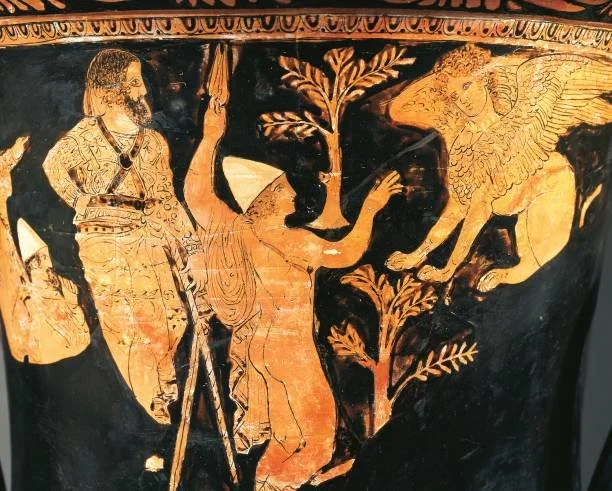
The play opens after Oedipus has just solved the Sphinx’s riddle and has been declared the "Savior of Thebes."
Savior and yet, if he does not confront his past, Destroyer…
But who was the Sphinx?
The Sphinx was an absolutely brutal creature. Herself the daughter of Typhon (the Storm-giant) and Echidna (the "Mother of All Monsters"), she was the literal offspring of chaos and violence. Yet rather than confront this horrifying reality of her own family lineage (or, we might say in more modern psychological terms, her “family system”), she suppresses it deep within herself in ways that progressively distort her femininity into monstrous proportions.
And how does the monster become manifest?
Though she still retains identifying features of a female with a woman’s head and breasts, her body becomes that of a lion (the “king of the jungle,” so to speak). Yet even more fascinating, from her lion’s body protrude wings for fight…as in to say, she pursues you wherever you go. And finally, as for her extremities they are the claws of very particular bird of prey—a vulture.
Not an eagle; not a falcon; a vulture, meaning that she does not pursue and kill the prey herself; she only arrives to claim what has already died (“For you have died…”). And when she does, she then devours the person whole…one by one.
The “Devouring Mother”
Viewed as the archetype of the “Devouring Mother,” she dominates her offspring through unremitting control (C. G. Jung, Symbols of Transformation in CW 5, §§260–270). And though she, in one sense nurtures her children, she ultimately dominates them, threatening at every moment to swallow their ego whole.
Her image, we might say, is the personification of a “mommy wound.”
And to apply it to our modern context, we could say that she is the overbearing ‘soccer’ or ‘homeschool mom’, who keeps children under her tight control in a way that prevents any genuine development outside of her dominance.
She takes her seat, as it were, over the mount of her family’s home, controlling the household through continual riddles...to which only she knows the answer. And ruling through this overweening psychological control, she keeps her family system under her mastery.
But that is not all, looking beyond her decent and lineage, we ask further,
Who was her sister?
And who was her brother?
The Hydra
Her sister, we discover, was the Hydra, the multi-headed serpent of proliferating trauma. Cut off one head and two more grow up in its place.
As in to say, fail to address the root cause and more pathologies emerge.
If we have sudden chest pain or worsening back pain or new vertigo or a wave of panic attacks or unremitting insomnia…and if our provider simply orders labs or imaging and prescribes medications, the symptoms may temporarily improve but two more worse pathologies may grow up in its place.
That is to say, when we treat Hydra’s new heads, the result is that more heads keep on emerging. Back pain becomes stomach pain becomes headaches becomes dizziness become fatigue becomes anxiety and depression.
And if our physician keeps ordering more tests or referring us to more specialist, we become like the woman with the “issue of blood,” who
“suffered many things from many physicians” and
“spent all that she had” but is
“no better, but rather growing worse” (Mk 5:26).
But that’s only the Sphinx’s sister, Hydra.
What about her brother?
From Hydra to Cerberus: The deepening layers of the unconscious
Going still further, the brother of the Sphinx was Cerberus, the three-headed dog that guarded the Underworld. The vicious guardian, we might say, of our personal, familial and cultural, unconscious worlds…who ‘barks’ and ‘bites back’ whenever we get too close to the truths we have so effectively buried (our personal unconscious).
Or our family has generationally suppressed (the generational unconscious).
Or our culture has blocked out of sight (the collective unconscious).
And upon such a city blinded and collectively held captive by what is staring them in the face…but they refuse to confront, the Sphinx finally descends.
The Sphinx, the “Devouring Mother,” that “cruel singer” (line 42), who traps her “children" (the developing ego), lulling them into a state of lifelong dependency and intellectual paralysis before she ultimately swallows them whole.
And so, the city of Thebes, blind to what actually threatens them most, believes they have been truly set free when Oedipus overcomes the Sphinx.
But is this really the case?
The riddle of the Sphinx
The Sphinx, we learn, had been sent to Thebes by the gods as a punishment for the crimes of the previous King Laius. Setting herself upon Mount Phikion, she ruled over the city through physical and psychological terror.
Demanding a deadly “toll” for passage, she spoke a riddle to every passerby. If they solved it, they could pass through unharmed. If they failed, they would be strangled (the word, sphingein, from which her name is derived, means to ‘strangle’) and then consumed alive (as it were, being already dead).
This sort of psychological oppression was incredibly unique because it gave the victim a false sense of agency. That is to say, they had the "opportunity" to save themselves through their intellectual powers, yet lacked the wisdom to do so. This is a critically important dimension of the play and will serve only to heighten its dramatic irony—intellect without truth will bring total blindness.
The Sphinx, however, before the start of the play’s drama, had been overcome by the mysterious newcomer, Oedipus, who, for his answer to her famous riddle, had ascended to the royal throne.
Her riddle:
“What goes on four legs in the morning,
on two legs at noon,
and on three legs in the evening?”
His answer:
“Man.”
Who as a baby in the “morning” of life crawls on four limbs;
as an adult at “noon” walks on two legs;
and as an old man in the “evening” of life, walks with a cane, a third leg.
And what happens when Oedipus solves the riddle that no one else before him had been able to answer?
Victory at one level; Defeat at another
Oedipus’ boldness in first standing up to the Sphinx and then answering her riddles with all the powers of his intellect brings him and the city of Thebes immediate victory.
The Sphinx, in a rather sudden, unexpected way, immediately “casts herself down from the citadel” in defeat (Apollodorus, Library, 3.5.8). No epic struggle; no violent clash. In fact, there is no resistance at all. Oedipus speaks the word and she “throws herself into the sea” to her death (Hyginus, Fabulae, 67).
The question, then, is why?
The power of his conscious-level intellect has overcome the “Devouring Mother,” freeing the city from her terrorizing control. The domination she exerted over Thebes through her unsolved riddles has finally been broken.
But—and this is the key—once she is gone, a much deadlier disease awaits…which is buried far below the surface in the dark layers of the unconscious.
Some commentators have even asserted that the Sphinx’s act of casting herself down to her death is but a stratagem to draw Oedipus into an even darker deception. That is to say, by her dramatic suicide she is enabled to secure a greater victory.
What??
How is that in any way possible?
The real battle begins
Though Oedipus has solved the puzzle in an abstract manner (“It is man”), he has failed to recognize himself in the story (“It is me”) as well as his family (“It is my father and mother”) since ancient sources held that the crimes committed by the royal house (his own house) were the reason for the scourge of the Sphinx.
And while Oedipus, through the light of his intellect, has overcome the enslaving power of this mythical beast, his victory over her will become the very means by which he will himself be blinded and then bound to a different mother—his own.
That is to say, her suicide embodies a failed initiation of the hero into manhood, the consequence of which will prove catastrophic, not merely to Oedipus, but also to the realm over which he now rules.
And this may be a reason why Sophocles seems to make such a point of the fanfare and hero worship of Oedipus by the populous after his initial victory:
“You came to Thebes and cut us loose from the bloody tribute we had paid that harsh, brutal singer (35-36).
“We taught you nothing, no skill, no extra knowledge, still you triumphed” (37).
“You gave us back our lives” (39).
“You are the mightiest head among us” (49).
“You are our life’s establisher” (57).
The first threat has been defeated…yet through his conscious-level, intellectual victory Oedipus has been lifted up into a blinding hubris that will keep him from actually seeing what is the true menace to the city.
From the Sphinx to the Plague: Our next question
Going still further, with the Sphinx now overcome, a new threat appears as a “deadly pestilence,” whose effects are far, far worse.
For this new disease is not terrorizing the inhabitants one by one, but destroying the city’s land and cattle, making “pregnant women lose their children” and filling “black Hades” with “groans and howls” as the “fiery god” strikes them down (22-31).
That is to say, whereas the Sphinx was an individual threat operating at the conscious-level through her riddles, the Plague is giving rise to darker, unconscious threats, suppressed for years and years, but now bubbling up from below the surface (Cerberus).
And whereas the Sphinx had been cast out, something far worse has now grown up in its place (Hyrdra).
All of this because the core issues have not been dealt with.
Oedipus has overcome a mythically terrifying beast; yet her siblings are still very much alive, ravishing the population through a pandemic.
And here, we might ask the question whether this infection, this “polluting stain” is not that “universal, hereditary sickness" …that “horrible, deep, inexpressible corruption” identified as…nothing other than…sin (Formula of Concord, Article I)?
A malady which does not distinguish between man, woman or child;
A disease that infects every person whom it touches;
A “deadly pestilence” that continues replicating and spreading until it has destroyed absolutely everyone and everything.
Conclusion: From “inexpressible corruption” to ineffable grace
Drawing this opening piece to a conclusion, we commenced with the theme of self-knowledge vs self-deception. And beginning with Greek Philosophy, we next moved into the realm of Greek Tragedy, where this philosophical understanding, so to speak, took on flesh and blood.
And there in Sophocles’ drama of Oedipus Rex, we encountered much more than a mere ancient literary tale; we discovered depths of psychological insight into the riddle not only of who we are as human persons, but moreover, how blind we actually are to our own histories…and how blind we are to who our family is…and how blind blind to what our culture is…and, finally, how blind we are to what threatens to destroy all of them.
And at this point, the riddle of the Sphinx advances beyond the domain of a mere intellectual enigma which can be solved through our conscious-level mind. Our brilliance avails us nothing here.
What is needed is honesty and courage.
Because what will be unleashed out of the unconscious worlds of Cerberus, our cerebral minds cannot handle. For when the Sphinx is intellectually overcome what remains beneath the surface is a much more “deadly pestilence.”
And it is into this all-encompassing pandemic which we will look in our next writing, which will require depths of ineffable grace.
To which we say in preparation,
Kyrie eleison!