Chrysostom on “Walking in the Midst of Snares,” Part I. “Perceive” and “scrutinize diligently” (Homily 15 On the Statues)
[Reading Time: 19 minutes
Introduction: 2 minutes
Historical Background: 6 minutes
Homily 15, Part I: 11 minutes]
Introductory questions
Why present a work from 1700 years ago?
Written to a people in ancient Syria?
By a former hermit whose extreme asceticism nearly killed him?
And who, when he did come back into society, was deemed to be a religious extremist?
Who was, therefore, condemned by a Synodal council?
Not once but twice!
And who, condemned and rejected, died as an exile?
Are such writings by such a writer worthy of our time?
The witness (martýrion) of John Chrysostom through the Ages
The preaching of John of Antioch was so impactful that he came to be called John, the “Golden-mouthed” (From chrysós + stóma).
And not merely was his preaching impactful in 4th century Antioch, but it has had a massive influence over the centuries, being held in high regard by Christians of all denominations and persuasions;
both East and West;
both Catholic and Protestant;
both Reformers and the Counter;
both Orthodox and Mystics;
From lay people to pastors;
From priests to bishops and popes;
From monks to hierarchs;
From Fathers to Patriarchs.
And so, this being the case, we present this initial writing with a question:
Does the witness of seventeen centuries of the Eastern and Western Church still stand?
And going further we ask,
Was John merely an ancient “mega pastor” of sorts who could “turn a phrase” to the exhilaration of the applauding masses?
Or was he rather a man, who himself had so deeply internalized the Gospel, then its healing truths flowed out from him as a balm, applied by the Holy Spirit, not only to the the viral chaos of his own culture, but to the infections of so many which have followed…all the way up to our present day?
And regarding his bitter end, we ask
Whether, as with Jesus (33 A.D.), as with James (44 A.D.), as with Peter (~65 A.D.), as with John (95 A.D.), as with Ignatius of Antioch (107 A.D.), as with Polycarp (155 A.D.), etc., etc., was it simply their powerful personalities that led to their death?
Or was it ultimately the power of the Gospel (euangélion), operating in each of them through the power of the Holy Spirit, that so exposed, and therefore, threatened the religious and political power structures of each era…such that they had no choice but to trump up false charges against them and use their serpentine power to condemn them, exile them and put them to death?
And though we won’t go through them here, Chrysostom was accused by none other than the Patriarch of Alexandria himself (Theophilus), who opposed John’s election to was the architect of the 29 formal accusations brought against John which were later executed by 36 bishops
(cf. Palladius [a contemporary and friend of Chrysostom], Dialogue on the Life of St. John Chrysostom, Chapters 6-8[408 A.D.]; Socrates Scholasticus: Ecclesiastical History, Book VI, Chapters 2–23 [c. 439 A.D.]; and Photius, Bibliotheca, Codex 59, which details the actual minutes of the Synod of Oak in 403 A.D. in which proceedings John was finally exiled [c. 845 A.D.])
But before we launch into his preaching, a few introductory words should be written about this particular set of homilies.
Historical background to John Chrysostom’s 21 Homilies On the Statues
The political spark: The Tax Riot (387 AD)
When Chrysostom set himself to address the people of Antioch (in what later become known as the Homilies On the Statues), a dire crisis was underway and the city faced the threat of total annihilation by the Roman government.
The issue was taxation.
In preparing to fund a grand celebration commemorating his tenth anniversary of rule in addition to underwriting a major military campaign, Emperor Theodosius I imposed a massive, heavy-handed tax on the city of Antioch. Being itself one of the "big three" cities of the Empire (alongside Rome and Constantinople), its citizens, already in throws of economic hardship, responded in a protest…that soon devolved into a violent riot.
In the mayhem, the mob tore down the statue of Theodosius and the statues of his wife and father (hence, Homilies On the Statues), dragging them through the streets with ropes. In the Roman world such acts were tantamount to nothing less than treason (majestas): An image of the Emperor was considered a legal extension of his person. Destroying his statue, therefore, was not just vandalism; it represented imperial treason. And the punishment, therefore, called for the destruction of the city and execution of its leaders.
The background to Homily 15: Imperial Rage
By the time of this fifteenth homily by Chrysostom, several weeks had passed since the initial Riot of the Statues. Imperial officials had arrested suspects and begun investigations. The bishop Flavian of Antioch had left for Constantinople pleading for clemency from the government.
What would happen next?
Heavy fines?
Loss of civic privileges?
Mass executions?
A wave of destruction?
We should note here that all of these had happened to rebellious cities before.
Historical precedents of imperial massacres beginning with Emperor Caracalla
170 years earlier during the brutal reign of Emperor Caracalla (r. 211-217 AD), who had ascended to the throne after murdering his brother, there was the Massacre at Alexandria (215 AD), where Caracalla had killed 20,000 (Cassius Dio, Roman History, Book 78).
And why exactly?
Because news had reached the Emperor’s ears of satirical verses in the city’s theatre, mocking him as the “the brother-slayer."
His response:
Organize a celebration of athletic games in the town center, then in the middle of the stadium gates, order his legionaries to form killing corridors, massacring every attendee.
And after the massacre the Emperor simply
“wrote to the Senate, not stating the number of those who had perished,
but saying that it did not matter how many or who they were, since they had all deserved to suffer" (78.23.1).
Then three years after these Homilies by Chrysostom in 390 AD, there would be the Massacre in Thessalonica under Emperor Theodosius I.
The Massacre in Thessalonica
And what would be the justification this time for the Emperor’s mass execution of 7000 people?
A riot over the arrest of a celebrated charioteer, who was going to be kept from competing in the upcoming games.
And what would the Emperor’s response be for their local uprising?
Continue with the games.
But, as with Caracalla before him, when the citizens were packed into the stadium, seal the gates from the outside and slaughter any and all who were present, be it men, women or children.
From the pen of Theodoret,
“When the imperial passion had received its authority, as though itself an independent prince, it broke the bonds and yoke of reason, unsheathed swords of injustice right and left without distinction, and slew innocent and guilty together.
No trial preceded the sentence.
No condemnation was passed on the perpetrators of the crimes.
Multitudes were mowed down like ears of grain in harvest-tide. It is said that seven thousand perished” (Theodoret, Ecclesiastical History, 5.17; cf. Sozomen, Ecclesiastical History, 7.25; and Rufinus, Ecclesiastical History, 2.18).
And it should be noted here that Ambrose of Milan (who we’ve featured here) directly confronted the Emperor, barring him both from entering the cathedral in Milan and from receiving the Eucharist. Though the details are, no doubt, complex, these actions by Ambrose contributed to an actual change in imperial policy. In what became known as the 30-day rulein the Theodosian Code, the Emperor enacted a new law, mandating a thirty day period between a sentence of death or confiscation of property and its execution.
Yet this pattern would continue as we conclude our introduction with one final example.
The Nika Riots in Constantinople
Two centuries later in the Nika Riots (532 AD), Justinian I would slaughter 30,000 in a single afternoon (Procopius of Caesarea, History of the Wars, 1.24.54, ).
Again we ask why?
Only five years into a reign which would span nearly four decades (527-565 AD), the Emperor had set his sights, not only on codifying Roman law and strengthening the empire’s religious authority, but even reconquering the western Roman provinces so as to restore the Empire to its former glory (renovatio imperii).
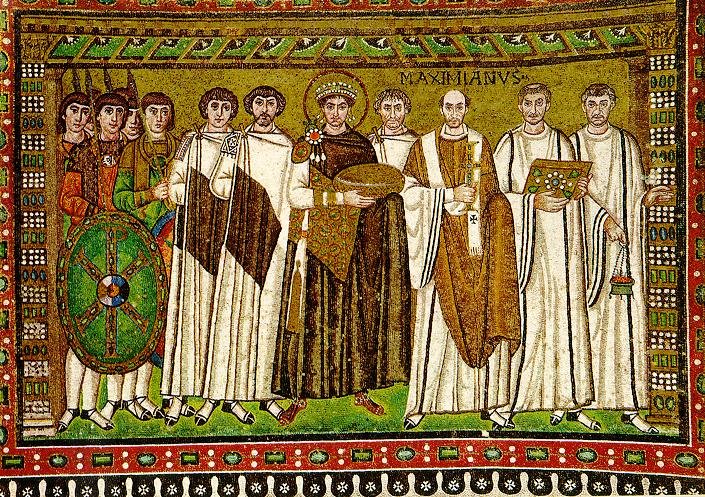
Justinian I – Mosaic in Ravenna
To do so, he imposed (as always) heavy taxes, which (as always) hit the middle and lower classes the hardest. Without going into great detail, there had arisen two factions, the “Blues” (Venetoi) and the “Greens” (Prasinoi), and over time there grew
“up in them against their fellow men a hostility which has no cause, and at no time does it cease or disappear” (Procopius of Caesarea, The History of the Wars, 1.24.1).
In January of 532 AD, the hostility broke into all out civil war.
We, again, ask why?
And again, at the center of the action would be the Roman stadium (Hippodrome).
Mass conflagration
Members of both the Blues and Greens had been arrested earlier for murder in the riots which had broke out on Jan 10th. In the ensuing execution, however, one member of each faction had survived (Chronicon Paschale, p. 114ff).
The mob rampaged through the streets, torching basilicas, bathhouses, public buildings and even the
“whole of the Great Church (the Hagia Sophia) together with its awesome and marvellous columns” (Chronicon Paschale, p. 117; cf. Procopius of Caesarea, The History of the Wars, 1.24.8)
in addition to the Senate-house and the Palace itself (Chronicon Paschale, p. 118-120).
It was utter mayhem to the degree that Precopius could only write the following in summation:
“so that I, for my part, am unable to call this anything except a disease of the soul” (Procopius of Caesarea, The History of the Wars, 1.24.4).
Kyrie eleison!
The response was swift.
“On the Lord's Day, that is on the 18th of the same month, early in the morning the Emperor went up into the Hippodrome to his own box, carrying the Holy Gospel.
And when this was known, all the people went up, and the entire Hippodrome was filled by the crowds” (Chronicon Paschale, p. 121).
With one final plea, the Emperor (combining the power of the Church with that of the State), declared to the rioters,
“By this Power, I forgive you this error, and I order that none of you be arrested, but be peaceful; for there is nothing on your head, but rather on mine” (Ibid.).
And the crowd began to chant:
“chanted
‘Augustus Justinian, may you be victorious' (nika in Greek; Hence the term, Nika Riots).
But others chanted,
'You are forsworn, ass.'
And he desisted, and the Emperor himself went down from the Hippodrome” (Ibid.)
The spectator-rioters now trapped in the Hippodrome (We have seen this before!), two Roman Generals (Belisarius and Mundus) proceeded to systematically execute 30,000 people
“without any distinction of age or sex” (Procopius of Caesarea, The History of the Wars, 1.24.54).
The anonymous 7th century author of the Paschal Chronicle increases the number to 35,000, stating that the soldiers
“began to strike the people at random, so that none of the citizens or visitors who were present in the Hippodrome survived” (p. 124).
All this to say, Chrysostom’s preached these Homilies with direct knowledge of the Emperor’s power and what could happen if he were enraged.
Back to Chrysostom’s Homily on the Statues with a word on the city of Antioch
Chrysostom was aware that in destroying the statues of the Emperor, the people could be executed on the charge of majestas (short for crimen laesae maiestatis: "crime of injuring the majesty" ), which in Roman Law encompassed any act by a citizen or individual that undermined the emperor or the republic and amounted to a capital crime.
Yet Chrysostom saw more than simply the chaos of the riot; he claimed that underneath it was the devil himself operating to “raze the foundations” of the city (15.1).
The city had been progressively reformed from a once lascivious place (not unlike modern day Las Vegas), known for its theater culture, public entertainments and riotous festivals. Before Chrysostom himself had even lamented that his sermons had little impact on reforming daily urban behavior.
But maybe…just maybe…these Riots on the Statues with all the historical precedents laid down in the past were the exact set of providential circumstances needed for deeper transformation. For as soon as the threat of imperial punishment loomed over them, which would have destroyed their theaters and closed their workshops (as in to say, destroyed their idols of entertainment and excess), Chrysostom saw something unprecedented happening:
The moral transformation of the city.
In his words,
“For by these very means through which the devil hoped to overturn our city, has God restored and corrected it” (15.3).
And with that introduction, we move into this fifteenth Homily of Chrysostom.
Homily 15 On the Statues
An introductory word on fasting and how it can lead to the opposite vice of excess
[1.] Today, and on the former Sabbath, it had behooved us to enter on the subject of fasting; nor let any one suppose that what I said was unseasonable. For on the days of the fast, counsel and admonition on that subject are indeed not at all necessary; the very presence of these days exciting even those who are the most remiss to the effort of fasting. But since many men, both when about to enter upon the fast, as if the belly were on the point of being delivered over to a sort of lengthened siege, lay in beforehand a stock of gluttony and drunkenness; and again, on being set at liberty, going forth as from a long famine and a grievous prison, run to the table with unseemly greediness, just as if they were striving to undo again the advantage gained through the fast, by an excess of gluttony; it might have been needful, that then as well as now, we should agitate the subject of temperance.
A further introductory word on the state of Antioch and the “fear of impending calamity”
Nevertheless, we have neither lately said anything of that kind, neither shall we now speak upon it. For the fear of the impending calamity suffices, instead of the strongest admonition and counsel, to sober the soul of every one. For who is there so miserable and degraded, as to be drunken in such a tempest?
Who is there so insensible, when the city is thus agitated, and such a shipwreck is threatened, as not to become abstemious and watchful, and more thoroughly reformed by this distress than by any other sort of admonition and counsel?
For discourse will not be able to effect as much as fear does.
And this very thing it is now possible to show from the events which have taken place. How many words then did we spend before this in exhorting many that were listless, and counselling them to abstain from the theatres, and the impurities of these places! And still they did not abstain; but always on this day they flocked together to the unlawful spectacles of the dancers; and they held their diabolical assembly in opposition to the full congregation of God's Church; so that their vehement shouts, borne in the air from that place, resounded against the psalms which we were singing here.
But behold, now while we were keeping silence, and saying nothing on the subject, they of themselves have shut up their orchestra; and the Hippodrome has been left deserted! Before this, many of our own people deserted us.
On the great benefits that come from the fear
[2.] Do you see what advantage has come of fear?
If fear were not a good thing, fathers would not have set tutors over their children; nor lawgivers magistrates for cities.
What can be more grievous than Hell? Yet nothing is more profitable than the fear of it; for the fear of hell will bring us the crown of the kingdom.
Where fear is, there is no envy;
Where fear is, the love of money does not disturb;
Where fear is, wrath is quenched, evil concupiscence is repressed and every unreasonable passion is exterminated.
And even as in a house, where there is always a soldier under arms, no robber, nor house-breaker, nor any such evil doer will dare to make his appearance; so also while fear holds possession of our minds, none of the base passions will readily attack us, but all fly off and are banished, being driven away in every direction by the despotic power of fear.
And not only this advantage do we gain from fear, but also another which is far greater. For not only, indeed, does it expel our evil passions, but it also introduces every kind of virtue with great facility.
Where fear exists, there is zeal in almsgiving, and intensity of prayer, and tears, warm and frequent, and groans, fraught with compunction.
For nothing so swallows up sin, and makes virtue to increase and flourish, as a perpetual state of dread.
Therefore it is impossible for him who does not live in fear to act aright; as, on the other hand, it is impossible that the man who lives in fear can go wrong.
Applied to the political chaos in Antioch—yet in a way that paradoxically worked for the strengthening of the foundations of Christianity in the city
[3.] Let us not then grieve, beloved, let us not despond on account of the present tribulation, but let us admire the well-devised plan of God's wisdom. For by these very means through which the devil hoped to overturn our city, has God restored and corrected it. The devil animated certain lawless men to treat the very statues of the Emperor contemptuously, in order that the very foundations of the city might be razed. But God employed this same circumstance for our greater correction; driving out all sloth by the dread of the expected wrath: and the thing has turned out directly opposite to what the devil wished, by the means which he had himself prepared.
For our city is being purified every day; and the lanes and crossings, and places of public concourse, are freed from lascivious and voluptuous songs; and turn where we will there are supplications, and thanksgivings, and tears, instead of rude laughter; there are words of sound wisdom instead of obscene language, and our whole city has become a Church, the workshops being closed, and all being engaged throughout the day in these general prayers; and calling upon God in one united voice with much earnestness. What preaching, what admonition, what counsel, what length of time had ever availed to accomplish these things?
On the benefit of going into the “house of mourning”
[4.] For this then let us be thankful, and let us not be petulant or discontented; for that fear is a good thing, what we have said has made manifest. But hear Solomon thus uttering a lesson of wisdom concerning it; Solomon, who was nourished in every luxury, and enjoyed much security.
What then does he say?
“It is better to go to the house of mourning than to the house of laughter” (Eccl 7:2).
What do you say, I ask?
Is it better to go where there is weeping, lamentation, and groans, and anguish, and so much sadness, than where there is the dance, the cymbals, and laughter, and luxury, and full eating and drinking?
Yes, verily, he replies.
And tell me why is it so, and for what reason?
Because, at the former place, insolence is bred, at the latter, sobriety.
And when a person goes to the banquet of one more opulent, he will no longer behold his own house with the same pleasure, but he comes back to his wife in a discontented mood; and in discontent he partakes of his own table; and is peevish towards his own servants, and his own children, and every body in his house; perceiving his own poverty the more forcibly by the wealth of others.
And this is not the only evil; but that he also often envies him who has invited him to the feast, and returns home having received no benefit at all.
But with regard to the “house of mourning” nothing of this sort can be said.
On the contrary, much spiritual wisdom is to be gained there, as well as sobriety. For when once a person has passed the threshold of a house which contains a corpse, and has seen the departed one lying speechless, and the wife tearing her hair, mangling her cheeks, and wounding her arms, he is subdued; his countenance becomes sad; and every one of those who sit down together can say to his neighbor but this, “We are nothing, and our wickedness is inexpressible!”
What can be more full of wisdom than these words, when we both acknowledge the insignificance of our nature, and accuse our own wickedness, and account present things as nothing?
Giving utterance, though in different words, to that very sentiment of Solomon — that sentiment which is so marvelous and pregnant with Divine wisdom —
“Vanity of vanities, all is vanity” (Eccl 1:2),
he who enters the house of mourning, weeps immediately for the departed, even though he be an enemy.
Do you see how much better that house is than the other?
For there, though he be a friend, he envies; but here, though he be an enemy, he weeps. This is a thing which God requires of us above all, that we should not insult over those who have occasioned us grief. And not only may we gather these advantages, but others also which are not less than these.
For each one is also put in mind of his own sins, and of the fearful Tribunal; of the great Account, and of the Judgment; and although he may have been suffering a thousand evils from others, and have a cause for sadness at home, he will receive and take back with him the medicine for all these things.
For reflecting that he himself, and all those who swell with pride, will in a little while suffer the same thing; and that all present things, whether pleasant or painful, are transitory; he thus returns to his house, disburdened of all sadness and envy, with a light and buoyant heart; and hence he will hereafter be more meek, and gentle, and benignant to all; as well as more wise; the fear of things to come having made its way into his soul, and consumed all the thorns.
The great benefit of fear
[6.] All this Solomon perceived when he said,
“It is better to go to the house of mourning than to the house of drinking.”
From the one grows listlessness, from the other an earnest anxiety.
From the one, contempt; from the other, fear; a fear which conducts us to the practice of every virtue.
If fear were not a good thing, Christ would not have expended such long and frequent discourses on the subject of punishment, and vengeance to come. Fear is nothing less than a wall, and a defense, and an impregnable tower. For indeed we stand in need of much defense, seeing that there are many ambushments on every side.
Even as this same Solomon again says admonishingly,
“Perceive that you go in the midst of snares,
and that you walk on the battlements of cities” (Sirach 9:13).
Oh with how many good things is this saying pregnant!
Yea, not less than the former! Let us then, write it, each of us, upon our minds, and carry it about ever in our memories, and we shall not easily commit sin. Let us write it there, having first learned it with the utmost exactness.
For he does not say, “Observe that you go in the midst of snares;” but,
“Perceive!”
And for what reason did he say, “Discern”?
He tells us that the snare is concealed; for this is indeed a snare, when the destruction does not appear openly, and the injury is not manifest, which lies hidden on all sides.
Therefore he says,
“Perceive!”
You need much reflection and diligent scrutiny.
For even as boys conceal traps with earth, so the devil covers up our sins with the pleasures of this life.
Sin lurking within the folds of pleasure: “Perceive” and “scrutinize diligently”
[7.] But perceive; scrutinizing diligently; and if any kind of gain falls in your way, look not only at the gain, but inspect it carefully, lest somewhere death and sin lurk within the gain; and should you perceive this, fly from it.
Again, when some delight or pleasure may chance to present itself, look not only at the pleasure; but lest somewhere in the depth of the pleasure some iniquity should lie enveloped, search closely, and if you discover it, hasten away!
And should any one counsel, or flatter, or cajole, or promise honous, or any other such thing whatever, let us make the closest investigation; and look at the matter on all sides, lest something pernicious, something perilous, should perchance befall us through this advice, or honor, or attention, and we run upon it hastily and unwittingly.
Life lived “in the midst of snares”
For if there were only one or two snares, the precaution would be easy. But now, hear how Solomon speaks when he wishes to set forth the multitude of these:
“Perceive that you go in the midst of snares.”
He does not say, that you go “by snares,” but
“in the midst of snares.”
On either side are the pit-falls; on either side the deceits.
One goes into the forum; one sees an enemy;
One is inflamed by the bare sight of him!
One sees a friend honored; one is envious! One sees a poor man; one despises and takes no notice of him!
One sees a rich man; one envies him!
One sees someone injuriously treated; one recoils in disgust!
One sees someone acting injuriously; one is indignant!
One sees a beautiful woman, and is caught!
Do you see, beloved, how many snares there are?
Therefore it is said,
“Remember that you go in the midst of snares.”
There are snares in the house, snares at the table, and snares in social intercourse.
Very often a person unwittingly, in the confidence of friendship, gives utterance to some particular of those matters which ought not to be repeated again, and so great a peril is brought about, that the whole family is thereby ruined!
For Part II. click here.
[Source: Translated by W.R.W. Stephens. From Nicene and Post-Nicene Fathers, First Series, Vol. 9. Edited by Philip Schaff. (Buffalo, NY: Christian Literature Publishing Co., 1889.) Revised and edited for New Advent by Kevin Knight. <http://www.newadvent.org/fathers/190115.htm>.]
Note: Section [5.] is not numbered in the above translation, as it skips from section [4.] to section [6.]. And for some reason section [13.] was not included in the above translation, but it was added from an Kindle version of the Complete Works of John Chrysostom, location 91077-91084.]