Who was Ambrose? And how he became the Bishop of Milan…amidst the raging chaos of the “Ariomaniacs” (Areiomanēs)?
[Reading Time: 15 minutes]
[This was originally written as the background for Ambrose of Milan’s extraordinary homily, On Naboth, the four section of which can be found here.]
Outline
Who was Ambrose of Milan?
His connection with Augustine
The hidden and communal life of Ambrose: West meets East
Background of the Arian-Nicene controversies
The exile(s) of Athanasius, the defender of Nicene Orthodoxy:
Into and out of the Desert
The Western Empire and the imperial overreach into Church affairs:
Constantius II: “My will is to be as a canon"
The Church pushes back: Ambrose’ unforeseen election as Bishop of Milan
How it happened? “From the mouth of babes…”
Ambrose’s initial resistance to the call (like so many others)
His final acceptance of his commission:
“Go, act—not as judge—but as bishop!”
Basil of Casearea’s Letter to Ambrose:
“Fight the good fight. Heal the infirmity of the people, if any are infected by the disease of the Ariomaniacs (Areiomanēs).”
Introduction: Who was Ambrose of Milan?
Before introducing his writings and homilies, we must first ask the question,
Who was Ambrose, the man?
A late fourth century bishop (as we may have known).
But before that (which we may not have known), an imperial provincial governor, whose own father had occupied one of the four highest civilian offices in the Roman Empire (more below).
A man, who while yet being a catechumen was, nevertheless, elected Bishop of Milan, a city which was the imperial residence and effective capital of the Western Roman Empire (due to its strategic position near the increasingly embattled Rhine and Danube frontiers).
A man, who would thereafter form and live the remainder of his life in an intentional Christian community (The Presbyterium), where he gathered around himself fellow believers and clergy so as to pursue that “community life for which our Lord had given the example.”
Even more, a man later to be spoken of as one of the four “Latin Doctors of the Church” together with Augustine, Jerome and Gregory the Great.
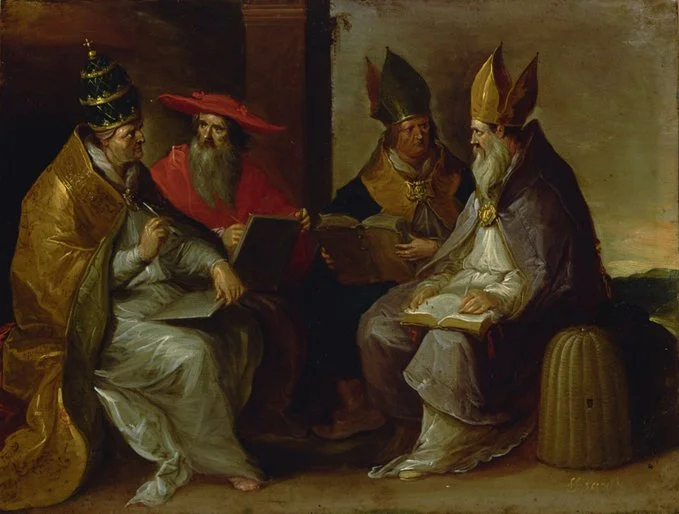
Frans Francken II, The Four Latin Fathers of the Church (c. 1620):
From Left to Right: Gregory is shown in the papal tiara, Jerome in the crimson of the cardinal, Augustine wearing a bishop’s mitre, and Ambrose with a beehive, which refers to a legend that had prophesized his future eloquence.
And while Gregory the Great would enter the political and ecclesiastical landscape two centuries later (c. 540–604), being like Ambrose, from a wealthy senatorial family and serving even as Prefect of Rome before his entrance into the Church, the remaining three were contemporaries.
But between Ambrose and Augustine (15 years his junior) there would form a deep, paternal bond, which would mark a turning point in the young Augustine’s life.
Of this, we should speak a brief word.
Ambrose and Augustine
As to his relationship with Augustine, Ambrose first met him when he had been sent from Rome by the praetorian prefect of Italy (Symmachus) to serve as a “teacher of rhetoric.”
More to the point, however, when Augustine arrived in Milan, he would describe himself as yet “straying amid the Manichæan deception,” being nothing more than a “careless and contemptuous spectator.”
In his own words,
“And to Milan I came, unto Ambrose the bishop—known to all the world as among the best of men—Your devout worshiper; whose eloquent discourse did at that time vigorously dispense unto Your people the
flour of Your wheat,
the gladness of Your oil,
and the sober intoxication of Your wine.
To him was I unknowingly led by You,
that by him I might knowingly be led to You” (Confessions, 5.13.23).
And how did this famed bishop receive this young rhetorician from the imperial capital?
“That man of God received me, a wandering man (peregrinationem), like a father.
And I began to love him, not at first, indeed, as a teacher of the truth—which I entirely despaired of in Your Church—but as a man who was kind and gracious to me” (ibid.).
This meeting with Ambrose would mark an absolutely critical stage in Augustine’s transformation with him remembering that he would attend Ambrose’s sermons, hanging on every word.
“And I eagerly heard him preaching to the people, not with the right motives as I should, but, as it were, trying to discover whether his eloquence came up to the fame thereof, or flowed fuller or lower than was asserted.
And I hung on his words intently, but of the matter I was but as a careless and contemptuous spectator…” (ibid.).
Yet through Ambrose’s continued, spiritual influence Augustine would not merely be
“delighted with the pleasantness of his speech” that was “more erudite” than his contemporaries;
he would be set on a path to conversion,
“drawing nearer gradually and unconsciously” (sensim et nesciens, ibid.).
In his fervent preaching, however, Ambrose would not only draw this future Doctor of grace (Doctor gratiae) to the “Father of mercies,” but he himself would be drawn by his own gracious preaching…into decades-long, ferocious battles with the imperial structures of the Roman Empire.
And it is for this lesser-known history that we present the below writing followed by a taste of his homiletics that would have the power, in Augustine’s words, to “heal the languishing soul” (ibid., 5.14.25).
The below lines will offer us a brief glimpse into the life of this figure who would change the course of Western Christendom in the waning years of the Roman Empire.
Ambrose and vital community
Much of what we know of Ambrose has been transmitted to us by Paulinus, a contemporary and friend of Ambrose who lived in the Presbyterium that was founded by the Bishop in Milan following his episcopal ordination in 374 A.D. Of this Presbyterium, it was said to have
“resembled a monastery in which St. Ambrose gathered about himself certain men of the Church, living with them that community life for which our Lord had given the example, and in which the holy bishop found great strength and personal joy.
‘It is a group of angels,’ writes he, ‘where one is occupied only in praising and serving God’” (Paulinus, Life of Ambrose, p. 2)
Living side-by-side with Ambrose amidst the rages of the Arian and Pelagian controversies of the late 4th century, Paulinus came to recognize in Ambrose
“a man of great asceticism and prayer,
a devoted and sympathetic father of the poor and unfortunate,
a zealous and watchful shepherd,
a daily example to all who surrounded him” (ibid, p. 3).
Becoming a great personal friend of Ambrose and part of his official ecclesiastical retinue, he served as his secretary for the two last years of his life. At his death, therefore, it was Augustine himself (a disciple of Ambrose), who would urge Paulinus to write a biography, which has come down to us as the Vita sancti Ambrosii—Life of Ambrose.
The life of Ambrose: West meets East
From Paulinus, we know that Ambrose was born into an aristocratic family in modern day southwestern Germany. His father, Aurelius Ambrosius, was the imperial viceroy of Gaul, one of the four highest civilian offices in the Roman Empire, administering a region
“roughly equivalent to the modern countries of France, Spain, Portugal, part of Germany, and Britain together with the islands of Sardinia, Corsica and Sicily" (Dudden, The Life and Times of St. Ambrose. Oxford: Clarendon Press, 1935).
As in to say, Ambrose came from a Roman family of the highest order. At the early death of his father, the family then moved to Rome, where Ambrose was formally educated, excelling in Greek, rhetoric, and law and coming to serve in the imperial administration under the praetorian Prefect of Italy (Paulinus, Life of Ambrose, 1.2.5; 2.4).
It should be noted here that his knowledge of Greek (to which Augustine and many other Latin theologians never had access) opened him up to the writings of the Eastern Fathers, from Athanasius to Cyril of Jerusalem; and from Didymus the Blind to Basil of Caesarea, whom he held in the highest regards and whose works he even went on to translate and adapt for a western audience (cf. Ambrose’s Hexameron [“Six Days of Creation”], which is a Latin adaptation of Basil’s homilies under the same name, etc.). Furthermore, Ambrose did not simply have access to these Greek patristic works, but he also acted as a Western champion of the Eastern Nicene Fathers, becoming a primary conduit through which Greek theology flowed into the Latin West. (And Basil’s own letter to Ambrose, quoted at the end of this writing, provides further evidence of this historical fact.)
In 370 A.D. at age 31, after his years of education and legal training, Ambrose would follow in his father’s imperial footsteps, serving as consul then governor of Aemilia-Liguria in Northern Italy, whose seat was Milan (ibid., 1.2.5). Three years into his governorship, however, something extraordinary happened that would extricate him from the world of politics and plant him in the soil of the church.
From politics into the Church: The pro-Arian and pro-Nicene background
His official residence at the time was in Milan, which importantly stood as the imperial capital of the Western Empire. Ambrose had just entered the beginning stages of his catechumenate in the church when the bishop of the city, a pro-Arian named Auxentius, died.
In electing a new bishop for the city, an ecclesiastical battle ensued between the Arian and Nicene parties within the church. The history here is important as political power and ecclesiastical authority would come into direct conflict, extending from the politics surrounding the election of a local bishop all the way to the Emperor himself.
The Roman Emperor at this time was Constantius II (r. 337-361 A.D.), the son of Constantine and a vicious Arian sympathizer, whose heretical opposition of Nicene Orthodoxy was only intensified by the influence of his Herodias-like wife, Eusebia. In 355 A.D., Constantius II convened an imperial Council in Milan, where he demanded the condemnation of Athanasius of Alexandria (298-373 A.D.), the primary theological champion of the Nicene Creed, and who, in the Emperor’s view, threatened the uniformity (not unity!) of the Church.
Note on Athanasius’ exile among the Desert Fathers and his discipleship under Abba Antony
It should also be noted here that Athanasius had already been exiled two times by this point (first in 335–337 A.D. under Constantine I; and second from 339–346 A.D. under Constantius II);
Yet it was during this third exile in the years of 356–362 A.D., where Athanasius would not merely take refuge in the wilderness of Nitria and Scetis with the Desert Fathers within the spiritual communities formed by Abba Antony…but where he would also become a disciple of Antony…to the degree that he would write Antony’s spiritual biography and receive from Antony his only material possessions in his final testament (Life of Antony, 91).
And this biography, we should further note, would exert a massive influence on the course of Western Christendom through Evagrius of Antioch’s translation of this biography into Latin, which work would specifically impact:
Augustine (cf. Confessions, 8.6.14-15),
Gregory of Nazianzus (cf. Oration, 21.5, 19-20),
John Cassian (cf. The Conferences), and
Jerome (cf. Prologue to the Life of Paul the First Hermit).
Not to mention the fact that this biography by Athanasius is still being referenced nearly two millennia later by historians, East and West. On this note, we could reference such monumental works as Derwas J. Chitty’s The Desert a City: An Introduction to the Study of Egyptian and Palestinian Monasticism under the Christian Empire (Oxford: Blackwell, 1966), which treats the Life of Antony as the foundational narrative of desert monasticism and traces its diffusion into the Latin West.
Or we could look to more recent works by Peter Brown, The Rise of Western Christendom: Triumph and Diversity, A.D. 200–1000, 2nd ed. (Oxford: Blackwell, 2003) and William Harmless, SJ, Desert Christians: An Introduction to the Literature of Early Monasticism (Oxford: Oxford University Press, 2004), both of which present Antony as the prototypical Christian, whose image given to us in Athanasius’ biography would shape the spiritual emphases of Western Christendom for the millennia to come.
Athanasius’ third exile with the sentencing of pro-Nicene bishops
How, then, was Athanasius exiled (again!) together with the pro-Nicene bishops?
Without going into great detail, this Synod at Milan was not a free assembly of bishops, but rather a staged judicial sentencing orchestrated by the Emperor to enforce the Arian cause; and in doing so, to undo the authority of the Council of Nicaea (325 A.D.).
In direct opposition to the Emperor’s will, however, the bishops this time refused to denounce and exile Athanasius. Moving to the heart of the matter, they then went so far as to place the Nicene Creed on the altar and demand the Arians sign it. Not only, however, did they refuse to sign it, but moreover, the Arian faction responded by causing a riot.
With his plot of imperial control failing, Constantius II then personally intervened, moving the faux Synod from the church into his private palace, where it would come under his full control. And from his imperial seat, the Emperor gave the pronouncement: banishment.
The “will” of the Emperor “as a canon”
Inside the palace, Constantius II then made the famous declaration:
"My will is to be as a canon" (Quod ego volo, pro canone sit [Athanasius, History of the Arians, Part IV, §33]).
What massive implications such a statement would have in the intensifying imperial controversies over Orthodoxy…
Seeking to reverse the tables on the pro-Nicene bishops, the Emperor then personally threatened the bishops with imprisonment and exile, if they did not fully subscribe to the Arian decree. As in to say, he used his imperial authority to personally reverse the Council of Nicaea (a trend which we will see again…).
Yet despite his threats, the pro-Nicene bishops stood firm, refusing to comply with the Emperor’s demands such that Constantius II imprisoned and banished the chief orthodox clergy and laity.
In Athanasius’ experiential synthesis which moves us behind the veil,
“In this manner it is that the Devil, when he has no Truth on his side,
attacks and breaks down the doors of them that admit him with axes and hammers…(ibid.).
The imprisonment and exiles importantly included the Bishop of Milan, Dionysius, in addition to such figures as Hilary of Poitiers, Eusebius of Vercelli, Liberius, the Bishop of Rome, and many others. And with Dionysius gone, Constantius II and Eusebia secured the Bishoprick for their pro-Arian ally, Auxentius, who would hold the position for two decades.
This now brings us up to the election of a new Bishop of Milan at Auxentius’ death in 374 A.D.
Ambrose elected bishop…“from the mouth of babes”
Though decades had passed, the exile of their former “blessed” bishop, Dionysius, was still fresh in the city’s memory (together with the imperial oversteps into church affairs). This time around, therefore, the people of Milan set themselves to elect a pro-Nicene Bishop at all costs (Paulinus, Life of Ambrose, 3.6).
Whether the following is “pure” history or not, this is the way that Paulinus relates the events of that winter day in 374 A.D.:
“Since the people in seeking a bishop were rising to revolt and it was his care to quell sedition, lest the people of the city should be turned to do harm to themselves, Ambrose proceeded to the church.
And there, while he was addressing the populace, the voice of a child is said to have suddenly cried out among the people:
“Ambrosium Episcopum—Ambrose Bishop.”
At the sound of this voice the mouths of all the people were changed, all crying:
“Ambrose Bishop.”
Thus those who disagreed most violently before, because both the Arians and the Catholics wished the other party to be defeated and a bishop of their own to be appointed, suddenly insisted on this one man with miraculous and incredible harmony (ibid.).
Ambrose’s internal resistance to his calling (like so many others…):
When the “I” blinds us to “He”
Yet Paulinus next tells us that Ambrose returned home, wishing
“to declare himself a philosopher” (3.7).
rather than be selected as Bishop in the tumultuous waters of Milan with the Emperor breathing down his neck…
Yet Ambrose’s response is not singular.
Think of Moses’ resistance to his divine commission, when called by JHWH to stand against the imperial forces of Egypt:
“Who am I that I should go to Pharaoh.
And that I should bring the children of Israel out of Egypt?” (Ex 3:11)
With him focusing further on himself and his own inadequacies,
“O my Lord, I am not eloquent…but I am slow of speech and slow of tongue” (Ex 4:10).
When Moses places all his focus on “I” his hopelessness is not incorrect:
“I cannot go against Pharoah.”
Correct.
“I cannot bring the children of Israel out of Egypt.”
Correct.
“I can barely speak at all...”
Yes. Exactly!
You cannot do any of these things in your strength alone;
But JHWH can.
And your commissioning is God’s paradoxical way of filling you—a weak and broken vessel—with divine strength from the Fourth-Dimension of His eternal throne.
Or remember Gideon’s response when he is commissioned to stand against the Midianites:
“O my Lord, how can I save Israel?
You cannot—only God can!
Indeed my clan is the weakest in Manasseh.
And I am the least in my father’s house” (Judges 6:15).
Yes, exactly! Because
“God has chosen the weak things of the world to put to shame the things which are mighty” (I Cor 1:27).
Or Jonah’s call to Nineveh—“that great city”—the capital of the Assyrian Empire, to which his response is simply…to flee in the opposite direction (Jonah 1:1-3);
Or Jeremiah’s later commissioning against the Babylonians
“Ah, Lord God!
Behold, I cannot speak, for I am a youth” (Jer 1:6).
Or think, finally, of the Apostle Paul’s resistance to the divine call…remembering that he had to literally be struck blind (Acts 9:1-9), so that he could receive a new, Fourth-Dimensional vision (Rom 8:31-39).
In this way, Ambrose first resisted his commission; but, in the process, would learn how to refocus from the “I” of self to the “He” of God so as to receive from Him all that he would need to carry out his divine calling in the chaos of 4th century Rome.
Ambrose’s resistance finally overcome;
His embrace of God’s calling to be a “true philosopher of Christ” and a “bulwark for His Catholic Church against its enemies”
Returning to Paulinus, it was the Lord’s will that Ambrose would become a
“true philosopher of Christ;
because despising worldly pomp, he was about to follow the footsteps of the Fishermen,
who united the people to Christ,
not by the ornaments of expression,
but by artless speech and by the doctrine of the true faith;
And being sent without wallet, without staff, they converted even the philosophers” (ibid.).
Ambrose, then seeing that he could not halt the events of his ordination, still struggling against his call, next
“prepared himself for flight, leaving the city at midnight” (3.8).
Yet, his efforts would again prove futile, as God surrounded him with those who would not release Ambrose from his commission. Finding him “at the gates of the city,” they simply would not let him go.
But even more, as Paulinus goes on to write, behind the will of the people (which, as we know, is fickle and can change in a moment), there was
“God, Who was preparing a bulwark for His Catholic Church against its enemies;
and erecting a tower of David against the face of Damascus (ibid.).
With Ambrose being “guarded by the people,” word was then sent to the
“most kind emperor Valentinian I (r. 364-375 A.D.),
who responded
“with the greatest joy” (ibid.).
Preparations were then made and Sextus Petronius Probus, the Prefect (Vice-Emperor) of Italy, who was “perhaps the most powerful private citizen of his age” and had already been Prefect of Ilyricum and Gaul, as well as co-Consul with the young Emperor Gratian in 371 A.D., was called to the proceedings.
By this point, however, Probus had already undergone his—we might say Pauline—conversion from a “vicious persecutor” of the Church to one who would have a “share in engineering the triumph of Nicene Orthodoxy in the West” (Tamas, From Persecutor to Arbitrator of Orthodoxy; The Changing face of Sextus Petronius Probus between the fourth and fifth century, 298).
The movements having now been set in motion, Ambrose would at long last submit to the divine Will (as Moses, as Gideon, as Jonah, as Jeremiah before him). Being brought to the Prefect Probus,
“when he was giving Ambrose his commission…said,
“Go, act—not as judge—but as bishop!” (ibid.)
This Ambrose would do.
And under Probus’ protection, he would maintain this position until his death nearly a quarter century later.
There may be no better way to close this opening writing than to quote from a letter to the newly elected bishop from Basil of Caesarea, a fellow combatant for the Nicene faith 1500 miles away in the far extents of the Eastern Roman Empire.
Basil of Caesarea’s Letter to Ambrose (375 A.D.)
In this letter, we find what great reverence an Eastern Nicene Father held for this newly appointed western bishop, who had given up a path of imperial power to struggle together with them for the Orthodox faith.
And going back to our title, it is in this letter that we find the term, “Ariomaniacs” (Areiomanēs), whose machinations against Ambrose will only escalate in the ensuing decades, infecting the imperial court and, as we will see in our next writing, leading to years of fierce resistance that will include repeated assassination attempts...
“Now I have become acquainted with you through what you have said. I do not mean that my memory is impressed with your outward appearance, but that the beauty of the inner man has been brought home to me by the rich variety of your utterances, for each of us speaks “out of the abundance of the heart” (Mt 12:34).
I have given glory to God,
Who in every generation selects those who are well-pleasing to Him;
Who of old indeed chose from the sheepfold a prince for His people;
Who through the Spirit gifted Amos the herdman with power and raised him up to be a prophet;
Who now has drawn forth for the care of Christ's flock a man from the imperial city, entrusted with the government of a whole nation, exalted in character, in lineage, in position, in eloquence, in all that this world admires.
This same man has flung away all the advantages of the world, counting them all loss that he may gain Christ (Phil 3:7-11) and has taken in his hand the helm of the ship, great and famous for its faith in God, the Church of Christ.
Come, then, O man of God;
Not from men have you received or been taught the Gospel of Christ;
It is the Lord Himself who has transferred you from the judges of the earth to the throne of the Apostles.
Fight the good fight.
Heal the infirmity of the people, if any are infected by the disease of Arian madness.
Renew the ancient footprints of the Fathers.
You have laid the foundation of affection towards me; strive to build upon it by the frequency of your salutations.
Thus shall we be able to be near one another in spirit, although our earthly homes are far apart.
Amen!
And Amen!
[Part II., How Bishop Ambrose survived the assassination attempts of the Queen Mother with the final Triumph of Nicene Orthodoxy under Theodosius I, is forthcoming.]