Psalm Superscriptions: Part III. The Paradox of Healing: From the “stoa” of ancient Greece through Athanasius and Calvin into the world of modern neuroscience
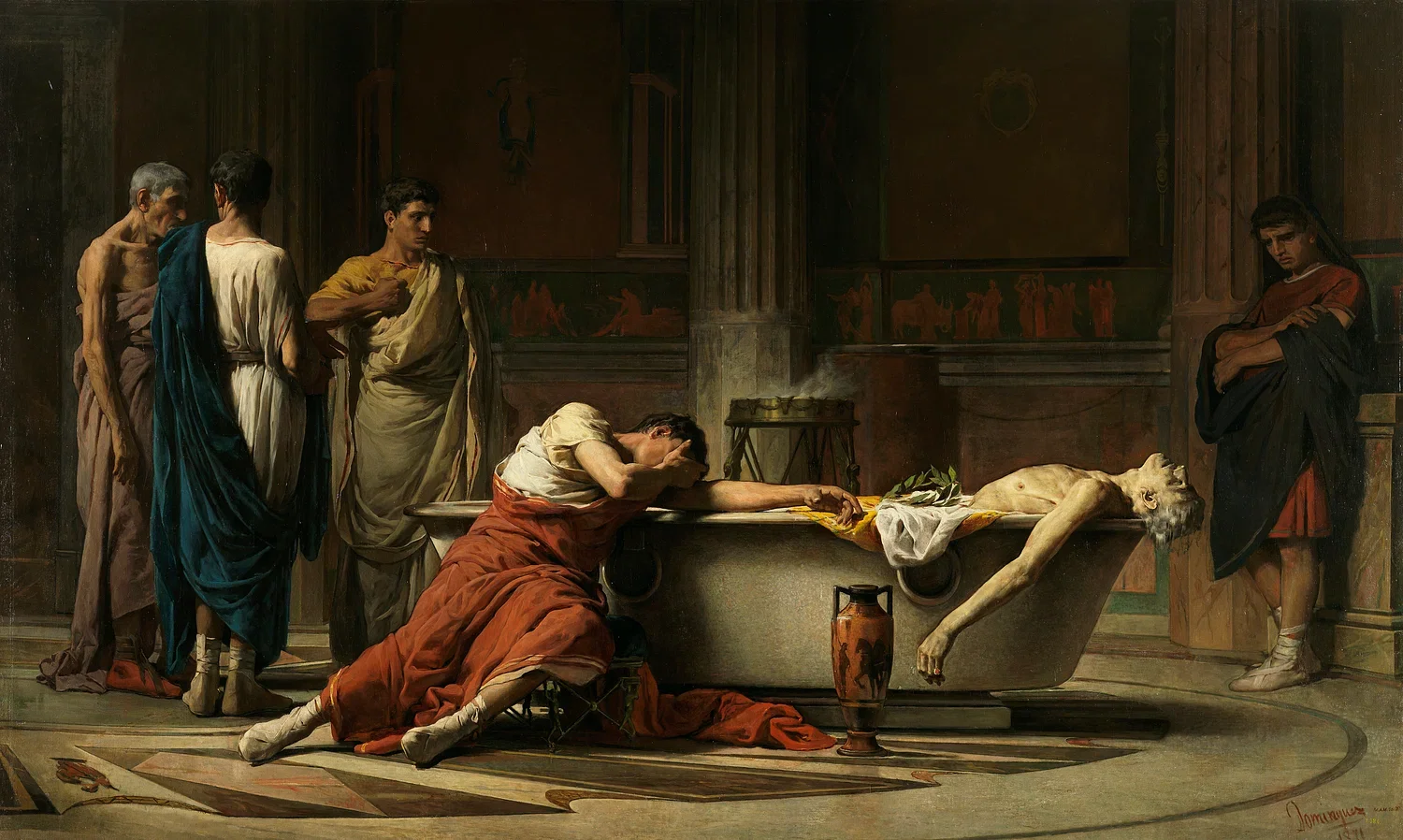
The Death of Seneca by Manuel Dominguez Sanchez, 1871. Museo del Prado
[Reading Time: 12 minutes]
Introduction: “An Anatomy of all the parts of the soul”
In a prior writing, we referenced an extraordinary statement from Calvin’s Commentary on the Psalms, which is well worth quoting again:
"I have been accustomed to call this book, I think not inappropriately,
'An Anatomy of all the parts of the soul';
For there is not an emotion of which any one can be conscious that is not here represented as in a mirror.
Or rather, the Holy Spirit has here drawn to the life all the griefs, sorrows, fears, doubts, hopes, cares, perplexities—in short, all the distracting emotions with which the minds of men are wont to be agitated" (p. 19-20).
In a strikingly similar way, Athanasius, a thousand years before, so spoke of the powerful inner-working of the Psalms, most especially in those who are suffering. He writes a letter to a “dear friend,” who is “enduring” a “present trial” and has “suffered many tribulations in it.”
[And we should mention here that Athanasius does not speak to his friend as some sort of philosopher writing from a wonderfully protected ivory tower, but as a fellow sufferer who was himself falsely accused, slandered and finally exiled under threat of death no less than five times by four different Roman Emperors…fleeing as we have before noted to the communities of Antony the Great in the Desert.]
From Calvin to Athanasius: The power of internalizing the Psalms
Athanasius begins the letter by noting that his friend, Marcellinus, on account of his sufferings, has come to
“read most frequently the Book of Psalms,” striving to “comprehend the meaning
contained in each psalm” (Letter to Marcellinus on the Interpretation of the Psalms).
But his striving is not merely an intellectual striving; it is an emotional exercise of internalizing the very words of the Psalms into his own heart and spirit:
“He who recites the Psalms is uttering the rest as his own words,
and each sings them as if they were written concerning him,
and he accepts them and recites them not as if another were speaking, nor as if speaking about someone else.
But he handles them as if he is speaking about himself.
And the things spoken are such that he lifts them up to God as himself acting and speaking them from himself” (Ibid, section 11).
And relating this back to the opening insights we drew from Calvin, Athanasius goes on to say,
“And it seems to me that these words become like a mirror to the person singing them,
so that he might perceive himself and the emotions of his soul,
and thus affected, he might recite them” (Ibid., section 12).
That is to say, a suffering soul, by “singing out” the Psalms, draws down the Holy Spirit’s revelatory power into his own experiences, so that he can truly perceive who he actually is (beyond all the projections), and thus, apply the words of Scripture rightly therein.
“For in fact he who hears the one reading receives the song that is recited as being about him,
and either, when he is convicted by his conscience, being pierced, he will repent (metanoéō),
or hearing of the hope that resides in God, and of the succor available to believer—he exults and begins to give thanks to God. …
And so, on the whole, each psalm is both spoken and composed by the Spirit so that in these same words, as was said earlier, the stirrings of our souls might be rasped, and all of them be said as concerning us,
and the same issue from us as our own words, for a remembrance of the emotions in us, and a chastening of our life” (Ibid.).
Extraordinary!
As one raised in the cerebral high tower of reformed theology, I may have missed these insights on the visceral power of emotion by Athanasius and Calvin. But their words are there, nonetheless…
And with this door of emotions unlocked, as it were, we found that, while other books of the Bible contain God’s words “to us,” the Psalms contain not only the prophets' words “to God,” but also, in Athanasius’ assessment, presents them as coming “from us.”
In this way, by the words of the Psalms, the human heart is laid open before the Divine.
And through the Psalmist’s own struggle with doubt, anger and fear, we, according to Athanasius and Calvin, are "drawn” by these deep emotions “to the examination” of ourselves, where we “perceive” who we actually are as we allow our "lurking places" to be discovered and our hearts to be brought into the light.
The Psalms, borne out of the hardships and trials of life’s experiences (ex-peirázō), not only reveal our own sicknesses and infirmities, but lead our heart beyond them—or, more accurately, through them!—to its cure.
Yet the question before us in this next writing is very simply,
“But How?”
Feeling our emotions as a critical first step towards healing: “Affect labeling” and the RVLPC
In embracing the entire spectrum of human emotions that exists within the complex architecture of the human heart, the Psalms enable us to first admit that we actually have emotions.
We are human beings; not human doings; not religious robots; not evangelical automatons.
Our brains do not function as religious processors that input the information of Scripture into our cerebral hard drives, which then work like a computer algorithm to output a course of action.
That is because there is simply no way to bypass the essential human element of feeling and emotion; for, as the world of neuroscience is now demonstrating, our ability to “feel our emotions” is critical to the healing process.
“Affect labeling,” which is the term given to naming what we are feeling, acts on a neurobiological level to increase activity in the Right Ventrolateral Prefrontal Cortex (RVLPC), which paradoxically enough, down-regulates and inhibits negative emotional responses from the Amygdala.
That is to say, naming and articulating the full emotional range of our experiences (in all their horror and pain) does not trap us in a maze of emotions.
No. Precisely the opposite is the case.
By naming what is happening in our lives (pressure at work, loss of job, struggles in our marriage, struggles with our children, struggles with our church community, betrayal by friends, falsely accused, gossiped, slandered, etc., etc.), then by admitting honestly how we’re feeling because of it (disappointment, anger, hurt, confusion, fear, rejection) become the very neurobiological means by which the visceral emotional grip of our experiences (again, in all their horror and pain) is broken.
As such this process is the way by which we regulate ourselves in the midst of life’s ‘slings and arrows’…yet, as it were, without even knowing it:
“Putting feelings into words, or ‘affect labeling,’ can attenuate our emotional experiences.
However, unlike explicit emotion regulation techniques, affect labeling may not even feel like a regulatory process as it occurs.
Nevertheless, research investigating affect labeling has found it produces a pattern of effects like those seen during explicit emotion regulation, suggesting affect labeling is a form of implicit emotion regulation” [Torre, J. B., & Lieberman, M. D. (2018). Putting Feelings Into Words: Affect Labeling as Implicit Emotion Regulation. Emotion Review, 10(2), 116-124].
In other words, naming what we’re actually experiencing and articulating the full emotional range of how we are feeling because of it becomes the means of regulating how we experience life.
And to link this back to our opening quote, this may be yet another reason why the Psalms are a central point between the Old and New Testament; They express nearly every conceivable human emotion and stand for us, nearly three millennia later, not merely as moving works of Hebrew poetic composition, but moreover, as living guides of how to experience life in This Fallen Age.
But isn’t that counterintuitive??
Teachings from the Roman stoa
This is definitely interesting since we may think of feeling and emotions in precisely the opposite way. Namely, when we’re faced with hardship, chaos or loss, we should become like the Greek founder of stoicism, Zeno of Citium. As a Phoenician merchant who himself lost everything in a wreck off the coast of Greece, Zeno learned to regulate his swirling emotions through newfound philosophical and psychoanalytic powers.
Taking these insights to the porches ('stoa') of the arcade, his teachings later took on the name, Stoicism.
Do not fear what you can lose.
Do not desire what you do not have.
Do not stress over things outside of your control.
Seek virtue, not pleasure.
Use reason rather than possessions.
Yes, excellent.
But what were its fruits?
Which takes us into the history of Rome from Caligula to Nero…
The History of the "Golden Age" of Stoicism
It is well for us to note at the outset that the era of Jesus and Paul was simultaneously the "Golden Age" of Stoicism, where stoic philosophy became the unofficial religion of the Roman elite. From Seneca (4 BC – 65 AD), through its further development in Epictetus (50 – 135 AD) to its pinnacle under Marcus Aurelius (121 – 180 AD).
And all this was happening amidst utter cultural and political chaos.
Seneca, a Roman Senator and a rising political star, was hated by Caligula, who ordered his death. But before he could carry out the execution, in 41 AD Caligula himself was assassinated. Having survived, however, this was only the beginning of his troubles. When Claudius next ascended to the throne, his wife (Messalina) accused Seneca of adultery…with none other than Caligula’s sister. And as a result of this false accusation, Seneca was exiled to Corsica for eight years.
When he was finally recalled back to Rome in 49 AD through the machinations of Claudius’ new wife (Agrippina the Younger), Seneca was placed as the tutor and advisor to her young son…who was none other than Nero (that ruled from 54-68 AD).
And how did that go?
Well, Nero, his pupil, full of paranoia and convinced that Seneca was a part of a plot to assassinate him, ordered Seneca to commit suicide in 65 AD (which was the inspiration for the image at the beginning of the article and which is detailed in Book 15 of Tacitus’ Annals, covering the years of 62-65 AD…which includes Nero’s burning of Rome in 64 AD so that he might “found a new city and call it by his own name”).
And what about Marcus Aurelius, Plato’s Philosopher King (Republic Book V.473d)?
How was the Empire managed in his reign, as Christianity was literally exploding at the seams?
From his Meditations, the question arises of how Emperor Aurelius—the most powerful man in the ancient world—could maintain his sanity amidst the chaos of the Antonine Plague and the Marcomannic Wars?
Covid was bad. The Antonine Plague was far worse. Stretching from 165–180 AD in its first wave and 251-266 AD in its second, the Plague killed upwards of 2,000 people a day in Rome and wiped out 10-15% of its total population (roughly 5 to 10 million people), including Marcus’ co-emperor, Lucius Verus, in 169 AD.
And beyond the cultural chaos induced by the Plague, there were in addition foreign invasions by a coalition of Germanic tribes (the Marcomanni and the Quadi), who breached the Danube frontier and, for the first time in centuries, reached northern Italy.
Without going into great historical detail, we can simply remember that it was under Marcus Aurelius that Justin Martyr was put to death through decapitation (c. 165 AD) and with his stoic leadership the horrific persecutions at Lyons and Vienne were carried out (177 AD).
But to move beyond the chequered history of Stoicism back to our main examination of emotional healing, there is content which is explicit; which is studied and learned (like the brief history above). And there are neural pathways for integrating this explicit content into our memory circuits (via sensory input to our entorhinal cortex [EC] which transmits the information through the hippocampus to CA1 pyramidal neurons, etc., etc. See “The Corticohippocampal Circuit, Synaptic Plasticity, and Memory” for more details if this in any way interests you).
The pathway above, however, is implicit. It something which happens in real time without our conscious awareness. It is something which occurs when we are simply being honest.
No self-projection; no mental gymnastics; no Stoic philosophical brilliance; just brutal honesty.
In the same article, the authors write,
“Successful emotion regulation might be thought of as an escape from something that elicits an emotional response in us, eliminating our feelings by avoiding or changing the way we think about the eliciting stimulus.
We probably would not think that focusing on our feelings without trying to change them could achieve the same effect.
Emerging evidence depicts a surprising kind of emotion regulation:
putting feelings into words…can itself be a form of implicit emotion regulation.”
One more neuroscientific insight
Even further, this process of naming our feelings acts to inhibit the outflow from the Amygdala (our emotional center) in a way that puts a neural brake on our flight-or-flight response (Koreki et. al. Epilepsia, 2020).
Or, to put in another way, our Amygdala which continually scans our environment for threats is like a smoke detector. When it "smells smoke" (detecting danger, stress, or a painful memory), it sounds the alarm in a way that triggers our fight-or-flight response, pumping adrenaline and cortisol throughout our body. Over the long term (as an entire other body of scientific literature has now clearly demonstrated), this neurophysiologic state of chronic stress has absolutely devastating effects on literally every organ system in our body [Though we do not have time to delve into this here, we will, no doubt, return to this phenomenon in future writings].
People, however, who can accurately perceive and “feel” their emotional state (interoception) have higher rates of recovery from chronic pain syndromes than those who are "alexithymic" and unable to identify their emotions (Shirvalkar et al. Nature Neuroscience, 2023). That is to say, by recognizing and admitting the emotional reality of what we are experiencing in all its frustration, misery and even horror, we can break out of the suffering loops of our pain pathways (De Ridder, Adhia, Vanneste, Neuroscience & Biobehavioral Reviews, 2021).
But to go entirely beyond the confines of neuroscience, it is a phenomenon that happens when we are internalizing the Gospel, as Athanasius so well articulated in his Letter to Marcellinus at the beginning.
Or more simply, in the words of Roger Bennett,
“If you can’t feel it then God can’t heal it.”
Which is to say, if we can’t actually admit that we’re angry or hurt or depressed or in a state of despair or spiritually cold or hard-hearted, we won’t look to the Lord for a new revelation of His healing mercies.
What we need, to quote the same pastor again, is
“not more information, but revelation.”
And what revelation, we might ask, does God gives us in the experience of suffering?
A question that draws us back to the book of Job, a masterpiece of wisdom literature that takes us from a simplistic understanding of suffering to a profound, living encounter with the Divine.
The pathway of Job: Admit. Embrace. Lament.
This actually seems to make a good deal sense of the literary structure of Job. As an inclusio, it begins and ends with Hebrew prose (Ch 1-2 & Ch 42) where the historical events of Job’s life are detailed for the reader—first the devastating, unspeakable losses then the glorious restoration.
Yet—and this is critical—the 38 chapters in between these two book ends are composed, not of dogmatic prose about the nature of suffering, but rather chapter after chapter after chapter of intense poetic outbursts.
Initially there is the starkness and blackness and brutal intensity of Job’s initial losses, for which there was no warning. Just like a devastating car accident. Or new cancer diagnosis. Or sudden death of a family member or close friend.
Yet when the unforeseen and sudden tragedy strikes, Job first primes his mind within the frame of the perfect providence of God:
“The Lord gave and the Lord has taken away;
Blessed be the name of the Lord” (Job 1:21).
And when his body is next struck from the “sole of his foot to the crown of his head” with an unspeakably painful disease, he again responds by placing himself entirely within the framework of God’s sovereign will, asking,
“Shall we indeed accept good from God, and shall we not accept adversity?” (Job 2:10).
Then, only after admitting the reality of his devastating losses; only after processing his own horrific bodily suffering does the real body of the book begin. That is to say, this work of Hebrew wisdom literature does not immediately close after Job’s heroic declarations of faith in the opening two chapters.
It goes on…and on…and on…
For 38 more chapters, as we have already noted.
“Deep things out of darkness”
Yet, in the horror and the pain and the losses so heart-wrenchingly described, we begin to understand together with Job that JHWH
“uncovers deep things out of darkness,
And brings the shadow of death to light” (Job 12:22).
We do not understand the profound truths of life by being bright into the “shining light” with its “brilliant illumination.”
No. Exactly the opposite.
Job is himself caught within the chaotic unknown of darkness with no light to guide him forward. He is trapped underneath the looming shadow of death.
And yet here, he comes to realize that it is specifically within the darkness; it is specifically under the shadow that we are ushered into a realm of deep discovery, not only of ourselves, but moreover, of God Himself.
It is here, in short, that we discover “wisdom.”
And so, it is no accident, therefore, that in these dark, shadowy chapters there erupts a great hymn to Wisdom, which concludes with the words:
“Behold, the fear of the Lord—that is wisdom,
And to depart from evil is understanding” (Job 28:28).
The “Why”
God does not answer Job’s "why" with prose logic; He answers him with poetic imagery of the cosmos (Pleiades, Leviathan, etc., etc.).
And in so doing, JHWH actually begins to Himself ask Job His own set of questions (76, in fact) while, all the while, failing to answer the 77th question…which is, we might ask,
“Lord, why am I suffering???”
God does not provide us in the Book of Job a dogmatic blueprint of how a Christian is to “suffer.” He does not offer us a complex theology of suffering, as wonderful as that might be.
The Book is, rather, a living dialogue composed, not in prose but in poetry, not on the Acropolis between two philosophers, but between a suffering man and his not-suffering-Pharisaical-condemnatory-Holier-Than-Thou neighbor who judges him at every turn.
Ever experiened that?
Suffering, vulnerable, wounded—indeed beaten down and left on the side of the road “half-dead.” And your Christians “brothers” come to you, not as as Jesus in the Parable of the Good Samaritan, so as to pour “oil and wine” into your bleeding wounds…but to witness your pain and then critique you for not suffering rightly. Even more, for bringing his suffering into your life because of your unconfessed sin.
Kyrie eleison!
Again, we remember that this is a part of the corpus of Wisdom Literature, and, as it were, marks out for us the very real experiences of pain and terror and abandonment with all the emotions that flow out of those experiences. And therein sets for us the pathway to true Wisdom.
A person; not a computer
The Scriptures do not bypass, but sanctify, human emotion.
And the Psalms that arise out of the depths of pain and terror, betrayal and despair, as we’ve just said above, become the “oil and wine” which the Lord Himself pours into our wounds.
For in admitting our emotions, it does not mean that we will then become immediately swallowed up in a tidal wave of feelings. Rather, it enables us to confront them in our conscious-level mind so that these emotions will no longer continue operating unchecked in the darkness of our sub-conscious. Which we will then act out without knowing it, all the while quoting Bible verses…
Yet, if we pause in the pain and look to the Lord, we discover that
“The unfolding of Your words gives light” (Ps 119:130).
And moving from David to the Apostle Peter,
“We have also a more sure word of prophecy (prophētikós lógos);
whereunto you do well in fully devoting yourself to it (proséchō),
as unto a light that shines in a dark place,
until the day dawn,
and the Morning Star arise in your hearts” (I Pet 1:19).
And still more, moving on to Paul,
“For God, who said,
'Let light shine out of darkness,'
has shone in our hearts to give the light of the knowledge of the glory of God in
the face of Jesus Christ" (Cor 4:6).
It is by this revelation that the
“lurking places are discovered,
and the heart is brought into the light,
where it is purged from that most baneful infection, hypocrisy.”
And by internalizing
“these inspired compositions that men will be most effectually
awakened to a sense of their maladies,
and, at the same time, instructed in seeking remedies for their cure” (Calvin’s Preface, p. 20).
Where these “inspired compositions” lead us: A paradox of healing
Our eyes being enlightened and our understanding being awakened to the reality both of our heart’s disease and its remedy, the Psalms then lead us into the pathway of healing.
Yet not one that would, at first sight, readily appeal to us; for in Calvin’s words, they will
“principally teach and train us to bear the cross.”
For it is only at the Cross, where we can come to experience a profound paradox:
The Cross, a place of excruciating suffering;
The Cross, a place of violence;
The Cross, a place of death;
will become for us
The one place where the infinite suffering from man’s sin meets the perfect, suffering heart of God’s infinite Love;
The one place where the endless violence of man’s rebellion is finally overcome by the purity of God’s inexhaustible Grace;
The one place where, in short, death is finally
“swallowed up in victory” (I Cor 15:54).
A paradox of suffering
We will there experience a twin paradox to that of healing. When we follow the footsteps of our Lord up to the Cross; when we give
“ourselves entirely to God, leaving Him to govern us, and to dispose of our life
according to His will,”
then even
“the afflictions which are the bitterest and most severe to our nature,”
will begin to be so transformed by His Grace that they will
“become sweet to us.”
For, over it all, we will come to find that they too
“proceed from Him” (Ibid, p. 21).
And so, from the dramatic events of the life and sufferings of David tied inextricably with our own, the Psalms open us to the full spectrum of man’s disease; yet in a way that usher us into the very presence of the Anointed King of Israel, Whose suffering heals His people and Whose death and burial brings our life and healing and eternal renewal into the light.
Amen!
So may it be!