Ekpeirázō (ἐκπειράζω): The infernal counterpart to peirázo and peirasmós—“Hypertesting”: An attribute of false communities which seeks not to reveal and refine but to destroy
[Reading time: 24 minutes]
[Note: This article has been reworked and augmented from its initial posting in Nov 2021]
Review
In our four posts on the word, peirasmós, we have found that testing in the Christian life is not only necessary to reveal the state of our heart (Deut 8:2-3), but it is also critical to refine it through the fires of trial which we are able to endure only as we remain with Christ in His peirasmós.
Introduction: The two-fold nature of each living word of Scripture
We now turn for a brief moment to what may be called the infernal counterpart of peirázo and peirasmós—ekpeirázō. As we have found in these word studies thus far, each word has a kind of life of its own. And as we begin to trace its life through the Scriptures, we find that it can always be applied in one of two ways:
It either reveals the pathway of life that operates within the Kingdom of God or it shows how life can be disfigured and distorted within the kingdoms of this Fallen Age. That is to say, there is a true application, where the word reveals the life of the Godhead operating in His people to transform and refine them into the deeper image of Christ; and, at the very same time, there is a false, contrived counterpart, whose power is only one of lifeless imitation.
The one is a way of light, creative power and Kingdom transformation; the other, a way of darkness, deception and unending death.
And with this introduction, we move into a study of ekpeirázō, which, we will find, continually operates within this later realm of contrived, and ultimately, destructive community life.
Etymology & Definition
From ek (‘out of’) + peirázo (‘to test’)-> “to test out to an extreme,” or, more simply, to “hyper-test.”
4x in the NT
Summary Synthesis
The first use begins with Satan himself, who reveals to us the demonic pathway of hypertesting. And this type of testing, as we quickly find, is aimed solely at deceiving, distorting, dismantling and destroying; for it is he himself who tests Christ “to the extreme” in the wilderness trials before the inauguration of His public ministry.
And Christ, in the midst of the snares of hypertesting, meets Satan’s distortions with the Word rightly applied.
Its next use then demonstrates how Satan’s infernal methods operate, not merely in the pagan world of darkness, but also in the religious systems of the world—in a “teacher of the Law,” who hypertests Jesus so as to both trap and entangle Him in the pathway of “justifying himself.”
Here again, Christ pushes the “expert” in the Torah to move beyond mere words to the actual application of the Living Word into the depths of his own person.
And thus, in each of Christ’s responses to the infernal hypertesting, He displays to us first, thatit exists; second, how it operates; and finally, how we are to respond. In regard to the first, Jesus makes very clear that hypertesting occurs most often in the realm of church life where “theological” words, accurate though they may be, are divorced from the life of God so as to be weaponized against the faithful.
And this pathway of “right” words and “right” doctrine, which is not applied to oneself but only to others, produces the fruit of accusation and division within a community.
Christ’s responses to such methods showcase how we ourselves are to confront, then overcome them. And this pathway first begins with applying the Word rightly to ourselves first—no one else.
This, then, leads to the final use of ekpeirázō, which takes us from Christ’s hypertestings to to the wilderness testings of Israel. And here we find in the narrative of the plague and the bronze serpent the final two steps. When we rightly and honestly apply the Word to ourselves, we are brought to understand the darkening, deceitful—venomous— poison, operating in our own hearts.
And this poison will, in the end, destroy us, our families, our communities, our churches.
Yet, when we confess the sickness, in Hawthorne’s words, of this Bosom Serpent, and then look to the crucified Savior, “lifted up,” we find in Him the potential for the real and enduring healing of our entire person. For He is the only One Who “Himself bore our sins in His own body on the tree,” receiving all the horror of it—all the poison of the serpent—into the depths of His own person to the degree that “He Who knew no sin became sin for us.”
And there in His broken, bleeding, crucified body, lifted up for us to see, the curse was broken, and the pathway to healing opened to all who are vitally united to Him.
Detailed Analysis
Satan’s hypertesting of Jesus in Mt 4 and Lk 4
This word first occurs in Satan’s “hypertesting” of Jesus in the wilderness aimed, as noted above, at His total destruction. It appears in the devil’s test of Jesus (the second in Matthew’s Gospel; the third in Luke’s) when he directs Jesus to “cast” Himself “down from the Temple” (Mt 4:6a; Lk 4:9).
In this we see the demonic distortion of Psalm 91’s promise that God will “give His angels charge over [Him]…lest [He] dash [His] foot against a stone” (Ps 91:11-12; qtd. in both Mt 4:6 and Lk 4:10-11). Responding to this distortion that the Gospel will somehow magically protect us [from, we might say, the reality of poor decision-making], Jesus quotes Deuteronomy 6, so to both reveal the misapplication of the Word, untangling it from the theological distortions of the fallen mind.
He declares to Satan,
“It is written,
‘You shall not put the Lord your God. to the test’” (ekpeirázō, Mt 4:7 & Lk 4:12).
And why, we may ask, are we not to “put the Lord to the test”?
God’s peirázo vs the devil’s ekpeirázō: Trials to refine vs Hypertesting to destroy
In our lengthy study of of peirázo and peirasmós, it became very clear to us early on that it only God Himself, Who truly knows, not only what we need in our often chaotic lives in this fallen world, but also how to use trials and testing in the exact right way at the exact right time in order to form us more and more into children of the coming Kingdom—children of the New Creation, who are formed after the image of His Son.
Satan, on the other hand, shows us at the very outset that he desires to take this prerogative away from God, using testing as a means to deceive us into destructive behavior…that we come to justify…precisely through the words of Scripture. Or, to put it another, darker way, the devil hypertests, distorts and deceives so as to form us more and more into the image of Hell itself (Ps 9:17).
Hypertesting in the Parable of the Good Samaritan:
The question from an “expert in the Law”
The next use in the Gospels moves from how Satan himself tests Jesus to how he operates through his infernal community in this age so as to destroy Him. And fascinatingly enough, we see these demonic operations at work, not in some kind of pagan realm of darkness, but in the community of Israel itself; not in some collection of immoral, dissipated, worldly people, but in the upright, moralistic, (self-)righteous system of Israel’s religious elite. Even more, it comes to us from the lips of one known to be an “expert in the Torah” (nomikos; from nomos—“law”).
Luke writes that
“a certain lawyer stood up to test” (ekpeirázō) Jesus saying,
“Teacher, what shall I do to inherit eternal life?” (Lk 10:25)
Yet before Christ answers, we know, from the way this word has already been used up to this point, that this man has no desire whatsoever to know anything about true life; he is simply trying, in the words of the Psalmist to “prepare a net” for Christ’s steps (Ps 57:6). And in setting his snare, he will utilize all the powers of the Law, all the force of Scripture, and all the resources of theology. Just as Satan before distorted the Word in the wilderness to Christ, this lawyer will now use the Word…to further distort the Word.
How, then, does Jesus respond?
He calmly yet firmly draws us back to a right application of the Scriptures through a simple question and response. Jesus asks this “instructor of the law,”
“What is written in the law?
What is your reading of it?” (10:26)
And the man actually answers this question rightly, accurately—scripturally even—quoting the synthesis from Deut 6:5 and Lev 19:18:
“ ‘You shall love the Lord your God with all your heart, with all your soul, with all your strength, and with all your mind,’
and ‘your neighbor as yourself’ ” (10:27).
From the theological question to the real-world application
To this theological question, Jesus then responds,
“You have answered rightly” (10:28a).
Yet Christ does not leave the matter here, as if a right answer with a right interpretation of right words alone were sufficient. He moves to the level of personal application, leading us to see that the Word must become internalized in the life and actions of each person.
So he adds the command,
“Do this and you will live” (10:28b).
Self-justifying hypertesting
This lawyer, however, does not want to apply the Word in any real way to his own life. Rather, he wants to keep the Word external to him, at arm’s length, so to speak, using it solely as a means to “justify himself” and accuse others.
So he responds by lashing back out at Jesus with his own question,
“And who is my neighbor?”(Lk 10:29).
And again, Christ responds calmly, not with a doctrinal diatribe, but with a simple parable of how a person’s despised enemy (the Samaritan) has compassion on him, treating him with the love of a neighbor…while the religious elites (the “priest” and the “Levite”) judge him and pass him by. “Wounded” and “half-dead,” they use their religious power, not to heal him, but to assuage their own guilt with darkening forms of self-righteousness.
Yet after giving the Parable of the Good Samaritan(Lk 10:30-35), Jesus asks the lawyer one final question so as to apply the teaching to him on a deeper level:
“So which of these three [i.e. The priest, the Levite or the Samaritan] do you think was a neighbor to him him who fell among the thieves?”
And again, the lawyer answers rightly, accurately:
“He who showed mercy on him.”
But his answer will soon be revealed for what is: well-spoken theological reasoning, yet void of healing power.
Beyond theology into the heart of a transformed life
Jesus is not here posing theoretical questions at what we might call an intellectual Bible study (with “intellectual” here meaning, not intelligence, per se, but using our intellects so as to keep us from actually feeling the full emotional weight of what is being conveyed; using our intellects so as to be neither moved, nor transformed by vital Truth).
No, Jesus is not impressed by the correctly-reasoned, intellectual answer of this expert in Halakhic legal codes. He is desiring, not a brilliant mind that is full of theological answers, but a heart that has been changed and a life that has been transformed by the Love which is the true foundation of the Torah.
And so He presses this foundational reality deeper into the core of this legal expert with one final word of application,
“Go and do likewise" (Lk 10:36-37).
As Watchman Nee said,
“Head speaks to head.
Heart speaks to heart.
But only transformed life can speak to transformed life” (The Ministry of God's Word, Chapter 8, "The Word Through the Man").
For
"God does not want just a mouth;
He wants a man...
The word spoken is the word that is lived."
The Final Use in I Corinthians
The transformed life that will flow from “doing” the commands of Christ by the Holy Spirit is set in stark contrast to that which emerges out of the divisive hypertestings of the demonic realm.
In the final occurrence of ekpeirázō in the NT, we are taken us back to the wilderness testings of Israel. And as we already worked through this passage in depth in the fourth post on peirasmos, we will quote the Biblical text first, then examine it from a different angle, namely that of its extraordinary OT allusion.
“Nor let us hypertest Christ (ekpeirázō),
as some of them also tested (peirazo),
and were destroyed by serpents” (I Cor 10:9).
In one word, so to speak, we are brought to clearly see the outcome of ekpeirázō: Destruction.
Yet there is, nevertheless, in this allusion the possibility for true healing.
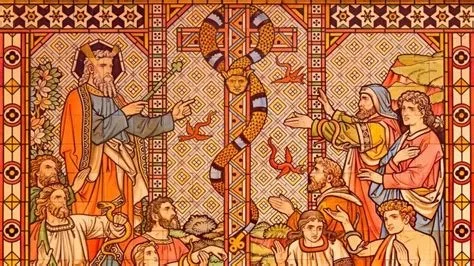
The Plague and the Bronze Serpent: Hypertesting, murmuring (lûwn) and “lodging” in our resentments
Paul is referring here, as we may remember, to the historical narrative of Numbers 21:4-8.
Here the children of Israel are in the midst of their wilderness wanderings, journeying around the borders of Edom, when they begin (again) to murmur(lûwn) against the Lord.
That is to say they literally “spend the night” (cf. Gen 19:2, Gen 24:23, 25, 54, 28:11, etc.—lûwn—same verb) in the “lodging” of their complaints and tightly held resentments (cf. Ex. 15:24, Ex 16:2, 7-8, Ex 17:3…Num 14:2, etc.).
Fascinating! but absolutely true:
We lock ourselves in the dark closet of our resentments—literally ‘feeling’ them (sentire) ‘over and over again’ (re-) until they re-shape our understanding of reality.
And our embittered understanding, though locked away, out of sight, deep in the dark closets of our unconscious, yet becomes the fuel, the volatile energy source, that propels all our actions…
In the words of the Big Book, this is what leads a person to relapse:
"Resentment is the 'number one' offender.
It destroys more alcoholics than anything else.
From it stem all forms of spiritual disease,
for we have been not only mentally and physically ill, we have been spiritually ill" (p. 64).
And how does this spiritual illness manifest in the Israelites?
From deepdiscouragement to bitter accusation
What begins with discouragement(Num 21:4b) soon turns to ingratitude. And this ingratitude next grows into anger and resentful accusation:
“And the people spoke against God and against Moses:
“Why have YOU brought us up out of Egypt
to die in the wilderness? (21:5a, cf. Gen 3:12-13)
Remember, chapters before, they had bitterly lamented that they had not already died:
“If only we had died in the land of Egypt!
Or if only we had died in this wilderness!
Why has the Lord brought us to this land to fall by the sword, that our wives and children should become victims?
Would it not be better for us to return to Egypt?” (Num 14:2-3)
With them even saying at that point that they would
“select a leader and return to Egypt” (14:4)
…as well as…
“stone” Moses, Joshua and Caleb “with stones” (14:10).
Kyrie eleison!
Who is JHWH? Can we remember?
Pausing in the narrative for a moment, we may ask the question(s),
Have they already forgotten their utter misery and affliction in their years of slavery in Egypt?
Have they already forgotten their cruel slave masters who
“made their lives bitter by hard service with mortar and bricks…” (Ex 1:14);
under which they had
“groaned because of the bondage” and “cried out” with a “desperate cry” to their Covenant God (Ex 2:23-25).
Going even further,
Has the bitterness of their slavery even caused them to forgot their God altogether?
Or, if they have retained some distant memory of God, have they now forgotten His character?
JHWH, Who had redeemed them with signs and wonders that the world had never before seen?
JHWH, Who broke the bondage of Egypt, destroying the might and glory of the ancient world’s most powerful and advanced kingdom in only a matter of days?
JWHW, Who then led Israel out from slavery “with an high hand”—not with the cowering fear of a runaway slave, hiding in the darkness from his captors at every turn—
But with the boldness of one fully vindicated by a Power far greater, who calmly walks out in the very midst of his former captors with confidence and full security (Ex 6:6-> Deut 26:8), as his captors themselves in terror ask for Israel’s very blessing on them (Ex 12:32).
JHWH, Who then opened to them a “land flowing with milk and honey”(Deut 26:9)
[…but which they ultimately rejected (Num 13:31-14:1)]
In the mind of the people of Israel—which had been progressively distorted by satanic hypertesting over these many, many years—they had finally come to view God as some sort of vengeful Father who intended nothing short of their day-to-day misery and ultimate, brutal murder.
But the question that we should ask is
Which Father?
Which type of Father is JHWH?
Are we speaking of the
“God and Father of our Lord Jesus Christ,
Who has blessed us with every spiritual blessing in the heavenly places in Christ” (Eph 1:3)?
Are we referring to the One Whose
“grace” (cháris) has been “freely poured out on us (charitóō [the verbal form of cháris]) in the Beloved (1:6)?
That is to say, in the eternal Son Whom the Father so perfectly loves (agapáō), and Whom He gives to us freely and unreservedly?
The One
“in whom we have redemption through His blood,
the forgiveness of sins,
according to the riches of His grace,
which He made to abound toward us in all wisdom and prudence (1:7-8)?
The One, through Whom, was “made known to us the mystery of His will, according to His good pleasure which God purposed in Himself”?
Accusations and the reality
But…since the Israelites are all actually still alive…and haven’t, in fact, “died in the wilderness” nor been “killed by the sword,” they next accuse Moses of not providing adequately for their needs:
“For there is no food and no water” (21:5b).
But…since there actually is sufficient “food and water,” then, like an angry child at the dinner table, they simply start complaining about the food:
“And our soul loathes (qûwts) this worthless bread” (21:5c).
And by “worthless bread,” they mean the manna—the “bread from Heaven”— that God literally provided for every person literally every morning.
The end effect of their seemingly endless murmuring is to lead the people into a state where they finally despise God’s providence in their lives and judge their Creator.
What, then, will be the result?
The judgement of “fiery serpents”
The result, as we well know, is the Lord’s judgment upon them, sending
“fiery serpents among the people, and they bit the people; and many of the people of Israel died” (21:6).
Now what?
Discouragement, ingratitude and anger that led the people deeper into resentful accusation—both of Moses and of God Himself—has now led the people into judgment. Yet we still ask,
Is there any way out?
Is there any judgment in mercy?
The Two-Stage Remedy
To this two questions, an answer is immediately given. No, they will not all die; for JHWH offers them in the midst of the judgment a pathway to healing; in the midst of death, a pathway to life.
And it comes in two stages.
The first is that they must confess their sin against the Lord with Moses as their intercessor.
“Therefore the people came to Moses, and said,
‘We have sinned, for we have spoken against the Lord and against you;
Pray to the Lord that He take away the serpents from us.’
So Moses prayed for the people” (21:7).
With confession and intercession comes the means of salvation…though in a rather strange and unexpected way.
What we find in the process is that the Lord in no way ‘takes away’ the trial. Rather, He uses it to reveal to them the reality of the venom in their own heart—“The Bosom Serpent,” as Nathanial Hawthorne came to speak of it.
Then the Lord calls upon them to look beyond themselves, beyond the deceitfulness of their own heart, beyond the impossibility of their situation, to a Reality that progressively heals them from the all-consuming, all-destructive, viral power of sin.
It is a paradox:
Admit the very thing that is killing you;
and this admission will open you to the remedy:
“Make a fiery serpent, and set it on a pole;
and it shall be that everyone who is bitten, when he looks at it, shall live” (21:8).
Every one who is bitten, in whom the curse of sin’s power is operative, is now given a choice:
Admit that you have been bitten;
Confront the fact that you will perish from the poison of the bite,
then look.
Spurgeon’s conversion story
Spurgeon encapsulated this powerfully when retelling his own conversion experience. Forced off the road in a bitter snow storm, in “darkness and despair,” he enters into an unknown church where, not the minister, but a layman, stands up to speak:
“I sometimes think I might have been in darkness and despair until now had it not been for the goodness of God in sending a snowstorm, one Sunday morning, while I was going to a certain place of worship.
When I could go no further, I turned down a side street, and came to a little Primitive Methodist Chapel. In that chapel there may have been a dozen or fifteen people. I had heard of the Primitive Methodists, how they sang so loudly that they made people's heads ache; but that did not matter to me. I wanted to know how I might be saved, and if they could tell me that, I did not care how much they made my head ache.
The minister did not come that morning; he was snowed up, I suppose. At last, a very thin-looking man, a shoemaker, or tailor, or something of that sort, went up into the pulpit to preach. Now, it is well that preachers should be instructed; but this man was really stupid. He was obliged to stick to his text, for the simple reason that he had little else to say. The text was
“Look to me all the ends of the earth and be ye saved” (45:22).
He did not even pronounce the words rightly, but that did not matter. There was, I thought, a glimpse of hope for me in that text. The preacher began thus:
“My dear friends, this is a very simple text indeed.
It says, 'Look.'
Now lookin' don't take a deal of pains. It ain't liftin' your foot or your finger; it is just, 'Look.'
Well, a man needn't go to College to learn to look.
You may be the biggest fool, and yet you can look.
A man needn't be worth a thousand a year to be able to look.
Anyone can look; even a child can look.
But then the text says, 'Look unto Me.'
Ay!'' said he, in broad Essex, ''Many on ye are lookin' to yourselves, but it's no use lookin' there.
You'll never find any comfort in yourselves.
Some look to God the Father. No, look to Him by-and-by. Jesus Christ says, 'Look unto Me.'
Some on ye say, 'We must wait for the Spirit's workin'.’
You have no business with that just now.
Look to Christ. The text says, 'Look unto Me.' ''
The power of a look in the right place to the right Person can totally transform; can renew, can bring life.
“So Moses made a bronze serpent, and put it on a pole;
and so it was, if a serpent had bitten anyone,
when he looked at the bronze serpent, he lived” (21:9).
From I Cor 10 to John 3—The Final Word: A Look
So we close this study by moving from this wilderness testing, where, again, the children of Israel, the Church in proto-form, absolutely fails. They murmur, just as we do when pressed and tested; they accuse; they are filled with resentment; they judge.
Yet the Lord meets them where they are.
And He meets us where we are, who respond in the exact same way as Israel.
For, we find, that the wilderness testings of Israel were written for us:
“Now these things became our examples, to the intent that we should not lust after evil things as they also lusted.
And do not become idolaters as were some of them.
As it is written,
‘The people sat down to eat and drink, and rose up to play.’
Nor let us commit sexual immorality, as some of them did, and in one day twenty-three thousand fell;
Nor let us hypertest (ekpeirázō) Christ, as some of them also tempted, and were destroyed by serpents;
Nor complain, as some of them also complained, and were destroyed by the destroyer” (I Cor 10:6-10).
Again, Paul declares,
“Now all these things happened to them as examples.
And they were written for our admonition, upon whom the ends of the ages have come” (10:11).
And then he adds this warning to us:
“Therefore let him who thinks he stands take heed lest he fall” (10:12).
Then this extraordinary encournagent:
“No temptation has overtaken you except such as is common to man;
but God is faithful, Who will not allow you to be tempted beyond what you are able,
but with the testing (peirasmós) will also make the way of escape,
that you may be able to bear it (10:13).
One look alone
“Only look to Me,” He says.
He, the Godman, strips Himself of His own divinity.
He comes to the exact place where we find ourselves.
He speaks our own language.
He identifies with us in all our pain; in all the injustice of our lives.
He comes to us in our abandonment by the religious systems.
And He takes into His very Person the poison of our sin; the poison of the “sin of the entire cosmos.”
And there, silent, bleeding, dying in love, asks that we, in return, only look.
Say nothing, but look.
And then in the throes of death, new life appears:
“And as Moses lifted up the serpent in the wilderness,
even so must the Son of Man be lifted up,
that whoever believes in Him should not perish but have eternal life”(Jn 3:14-15).
From hypertesting of us to full identification with us
When the hypertesting causes us to doubt, to disbelieve, to distrust, we are in this final occurrence of ekpeirázō given finally no “theological” words at all.
We are presented, rather, with a crucified Savior and asked to look, to see the One Who took the venom of the serpent into “His own body on the tree.”
And when we, His body on this earth, form into a genuine community in and through this crucified Christ, our lives together will no more be marked by judgement and infernal hypertesting, but rather by the mercy of the Good Samaritan—the mercy of Christ Himself—Who bears in Himself the horror of our sin and in Himself atones for them fully, finally and unreservedly.
No longer will we use the words of Scripture to hypertest one another; no more will we
“strive about words to no profit,
to the ruin of [our] hearers” (II Tim 2:14).
But becoming more and more like the Good Samaritan—more and more like Christ Himself—we will learn to “rightly divide the word of truth”(II Tim 2:15); and rightly apply the Word of God, not to guilt and shame a suffering soul, but in a way that holds out to them the healing balm of the “oil” and “wine,” which is poured out in Christ’s own suffering for struggling and imperfect brothers and sisters, for wounded sons and daughters, for dear friends and colleagues…for those, in short, alone on the side of the “road,” “robbed,” “beaten,” abandoned by the religious systems of This Age and left “half-dead.”
And directing them to look up to the crucified Savior from the exact point of where they actually are in all its mess and pain and unmanageability, what they will find in that one look is an entrance into a new world of Fourth-Dimensional healing, a resurrection world of new and unending life.
Amen!
May it be so!