Hypomonḗ (ὑπομονή). Part I: Persevering endurance as the Spirit plants the seed of the Kingdom in the now “beautiful ground” of our Heart enabling us to endure all the trials (thlîpsis) of life
[Reading time: 13 minutes]
Introduction
How do we persevere?
How do we respond to all the sudden, unforeseen twists and turns of life?
Or, what may be much more challenging, how do we continue through the less dramatic but increasingly prolonged, day-by-day, or even hour-by-hour, hardships and trials that seem to keep going…and going…and going for a lifetime?
Whether that may be a life-changing diagnosis? In ourselves or a family member? An incurable disease? A devastating loss? A broken relationship? An impossible situation at work? An impossible situation in our family? An impossible situation in our finances? An impossibly difficult conundrums, where the more we “do” only seems to make it worse…
Is our response in all of this just to “work harder”? The main issue is that we haven’t “done enough.”
Or, do we actually need to “work smarter”? We’ve wasted a lot of time and resources on ineffective methods. And if we figure out all these details…then we won’t need to work as hard (and…therefore, we won’t actually need perseverance…).
Or, are we spiritually out of tune? Do we need to pray more? Read more Scripture? Lead more Bible studies? Start a new ministry?
As in to say, do we simply need to “do more”? Do we need, as Roger Bennett, says more “do-do religion”?
Our answer comes in the form of a question, which is,
What do the Scriptures say?
And we will explore this question through the lens of our next two word studies on what appears an increasingly crucial concept as the years of our lives keep piling up: “persevering endurance.”
Hypomonḗ (ὑπομονή)
Etymology & Dictionary Definition
This term is formed from the verb, hypoménō (ὑπομένω), which is derived from hypó + ménō
And means to literally ‘remain’ (ménō) ‘underneath’ (hypó) the weight of our circumstances, trials and afflictions. As is so often the case, especially when our circumstances do not appear change, but may even intensify (like David being hunted in the Wilderness for—not months—but years…). This word, then, conveys the idea of ‘enduring with perseverance’.
32 occurrences in the NT:
2x in the Gospels (both in Luke);
6x in Romans (which will be the main focus of this and the next writing);
With 7 further occurrences in the Epistles of Paul;
2x in Hebrews;
3x in James;
2x in II Peter;
7x in Revelation
The Gospels
Summary Synthesis
The persevering endurance that marks the “seed that falls on good ground,” which enables a pathway through all the testing, trials and shakings of this life unto the very end of the age.
Detailed Analysis
The Parable of the Sower
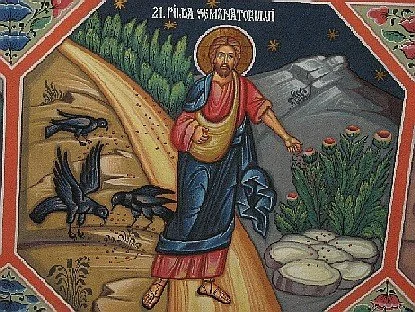
Hypomonḗ occurs only two times in the Gospels, both spoken form the mouth of Christ Himself in the Gospel of Luke. The first instance comes at the close of the Parable of the Sower, where Jesus explains that it is not the seed that falls “by the roadside,” which can ultimately “bear fruit”…since it is immediately “trampled underfoot,” as if it were of no value at all.
Nor is it the seed that falls on “rocky ground,” which grows up in a moment but, rootless and disconnected from the nutrients of the deep soil, immediately “withers away” as soon as “tribulation or persecution arises on account of the word.”
Nor is it the seed that falls “into the middle of thorns” whose spiritual life is soon strangled by the “cares of this world” and the “deceitfulness of riches” and the “pleasures of this life,” which grow up together with it (symphýō), almost seamlessly in their family systems, reinforced in their schools, unchecked in their churches. For Jesus makes absolutely clear that wealth and status with all the pleasures they afford us have absolutely no power to bring forth any life in us.
But what is more, these things (which we blindly push our children into…) become the very things that will progressively “choke” the seed of the Word that it “bears no fruit unto perfection” (telesphoréō).
Kyrie eleison!
What seed, then, will be planted in such a way that it actually can bring forth lasting fruit?
The seed cultivated in the “good” or “beautiful (kalós) ground” of our heart
These three paths represent every pathway of life in This Now Age, which will keep us from bearing fruit unto eternal life. It is only, we discover, the seed which falls “on good ground” (kalē gē) that will ultimately bear fruit.
What does this mean?
In Jesus’ words, this is the seed which is received
“in a beautiful (kalós) and good (agathós) heart.
This identifies those who
having heard the word, keep it,
and bring forth fruit with persevering endurance” (en hypomonḗ, Lk 8:15).
From its very first occurrence, then, we see that this word is inextricably tied to the life of salvation:
It is only the seed that falls into an “honest/virtuous/excellent/precious—beautiful (kalós) heart,” which can truly “hear and understand” in a way that will enable the seed-bearer to persevere through all the trials that will come against him in this Passing Age so as to bring forth fruit unto eternal life.
The next use makes this even more explicit.
Persevering endurance in the Tribulation
Because of this intrinsic connection between salvation and endurance, the “fruit” we bear is not that which dies on the vine, but it is “fruit” that will continue “unto eternal life.” As such, this species of fruit can only be brought forth “en hypomonḗ.” And thus, these testings and trials will come to progressively mark the life of a genuine believer from the conception of his faith unto the very end.
At the center of Jesus’ words to the disciples concerning the Destruction of the Temple (Lk 21:4-19), the Fall of Jerusalem (21:20-24), the End of the World (21:25-26) and the Second Coming of Christ (21:27-28), He declares to them,
“In persevering endurance (en hypomonḗ ) possess your souls” (Lk 21:19).
Amidst the hardships and shakings of life in This Fallen Age (Lk 21:23, 25, 26-> Heb 12:26-28) together with the personal trials that will soon encompass us—betrayal, persecution and even death (21:16-17), Jesus assures us that not
“one hair of [our] head shall perish” (21:18).
Through it all we will be kept in the center of God’s perfect will, persevering unto salvation in the pathway of hypomonḗ (21:19).
And moving, then, from the Gospels into the Epistles, we discover that this pathway is tightly linked with continual repentance (metánoia).
Romans
Summary Synthesis
Hypomonḗ leads us in a pathway of continual repentance (metánoia) throughout all the trials of this life unto the Final Judgment. That is to say, it continually changes (metá) and refines our framework of understanding (noiéō) enabling us to more clearly see that every hardship and trial (thlîpsis) that we experience will become the very means of working this salvation deeper and deeper into our person, as the Holy Spirit pours the love of God into our hearts through all of it.
Detailed Analysis
Equipped with the thing most needful (chrēstós) enabling true repentance (metanoia) and persevering endurance (hypomonḗ)
The persevering endurance of the saints is made explicit in the next six occurrences in the Book of Romans. And it is here in its opening occurrence in the Epistles where we find that is is the
“goodness (chrēstós) of God”
—not our brilliant understanding;
not our depth of analysis and precision;
not our high-level religious performance;
not our flawless completion of all duties and assignments;
not our enthusiasm in our work nor creative expansion beyond it—
which ultimately leads us
“into repentance—into this new “framework of understanding” (metanoia, Rom 2:4).
For the Greek word typically translated as “goodness” or “kindness” (chrēstós) has a much greater depth of meaning than what is conveyed in our modern usage. Derived from the verb, chráomai, which means to ‘use or furnish exactly what is most needed,’ the noun form comes to mean ‘that which is most needful.’
And for this reason in the Gospel of Matthew, Jesus says very simply,
“My yoke is chrēstós, and my burden is light” (Mt 11:30).
As in to say,
‘My yoke is the exact thing that you most need.
And when you bear this yoke—and not the yoke of the religious system which “binds” you with “heavy burdens, hard to bear”),
then My burden will actually become to you something light.
You will be bearing it without knowing you’re bearing it, because I will be in you bearing it with you.’
Our understanding changed; our heart reshaped so that it may continue “with persevering endurance in good work”
The “chrēstós of God” is what, therefore, leads us into the new paradigm of understanding, which come to mark the life of a true believer. This is what reshapes our “heart,” which was formerly
“hard and impenitent (ametanóētos: Literally ‘unable [a] to repent’ [metanoéō])
Which formerly spent the entirety of its life here on earth, treasuring up for itself [thēsaurízō])
“wrath against the day of wrath and revelation (apokálypsis) of the righteous judgment of God” (Rom 2:5).
Absolutely terrifying but undeniably true.
But now, receiving from Christ the transformed life of true repentance (again, metanoia), we are gifted with the ability to continue through all that may come our way
“with patient endurance (kata hypomonḗn)
in well doing.”
Before hardships and trials frustrated us, angered us, even scandalized us…“ Why do I have to go through this…again?”
Now, however, the trials operate in us to call forth from us ever deepening levels of persevering endurance (hypomonḗ), which will enable us to bear forth the fruit of “good work” (érgon agathós) through the Holy Spirit.
It is not the struggle and then the good work.
The struggle itself is the good work.
And whatever the particular relation may be, one cannot separate the two.
“Getting through” or stepping into the Hero’s Quest
Or to look at it from another vantage point, we could say that we are not simply struggling through every stage of our lives until we finally bear some kind of good, visible, measurable fruit. And until that point, we simply bury our head in the sand so we can “just get through” and finally, escape off to “Heaven” someday.
No.
To go back to the Hero’s Quest in the Arthurian Legend, we do not hide out in some little hidden corner of safety. Rather, we enter the forest at precisely the point where it seems the darkest. For it is, as we found in our exploration of Oedipus Rex, the things that we (and our family) bury in the darkness…which we bury alive. And in this way, they will continue operating below the surface in our personal and generational unconscious…until we are enabled by the grace of Christ to finally confront them in all their darkness.
Yet to do this requires the fruit of the Spirit of hypomonḗ.
Hypomonḗ, then, is that which the Holy Spirit Himself gives us. And this gift, which is freely given to us, operates within us carrying us through all the “slings and arrows” of our life in This Fallen Age into the glory of eternity. This, then, is the dimension of hypomonḗ as it relates to our eternal salvation.
Which is what the next verse makes absolutely clear.
From Rom 2 to Rom 5: The paradoxical pathway of Grace ∞ Joy
As we persevere in doing good, it unequivocally demonstrates that we are squarely set on the “narrow and hard path” seeking for
“glory and honor and immortality, eternal life” (Rom 2:7).
And yet, interestingly enough, most of our good work will consist of unconscious acts and therefore, be completely unknown to us. In Jesus’ words, our “left hand” will not even know what our “right hand” is doing (Mt 6:3); For our actions will flow out of our vital union with Christ.
We will be ‘working,’ yet He is doing the work;
giving, but He is providing us with all we have;
persevering, yet He is the One filling us with strength.
And a fruit of life on this paradoxical path will be an other-worldly “peace”:
Having been
“justified by faith,
we have peace with God through our Lord Jesus Christ” (Rom 5:1).
And through Jesus,
“we have access by faith into this grace wherein we stand” (5:2a).
We have now entered into a totally new dimension.
And we stand here in and through the continual working of grace. With grace operating deep within us, then, our hearts are opened up to indescribable joy regardless of our external circumstances. And we come to understand that there is an intrinsic connection between the two:
Grace ∞ Joy.
For there is even an etymological connection between them, as the noun, ‘grace’ (cháris), derives from the verb, ‘rejoice’ (chaírō)…which is the root for ‘joy’ (chará), ‘healing’ and ‘forgiveness’ (charízomai).
We have begun to
“taste and see that the Lord is good” (Ps 34:8).
And tasting the goodness of God progressively opens us up to greater dimensions of “hope.” Which, we might say, means that we simply hope for more of the Lord and what He alone can give us.
Our focus has thus shifted from the temporary attractions and distractions of This Age, which we have come to recognize by this point in our lives won’t actually satisfy us. And as grace is operating, we are brought to a place where we
“rejoice in hope of the glory of God” (5:2b).
We will need these twin fruits of the Spirit shaping and reshaping our understanding for what comes next.
Into eternal glory through life’s bitterest and darkest trials: thlîpsis ∞ glory
What is quite incredible here—in fact, totally impossible in worldly terms—is that when grace is operating in us with hope, we are actually…brought into “glory”…precisely through the tribulation/hardship/pressures (thlîpsis).
That is to say, when the jaws of the vice (a more technical way to describe the actions of thlîpsis from its verbal root, thlibó) begin enclosing us in its grip—at that very point—we “glory.”
How? Why?
Because we know that the thlîpsis will become the very means through which the Lord will work into us “persevering endurance”:
“And not only that, but we also glory in tribulations (thlîpsis),
knowing
that tribulation produces (katergázomai) persevering endurance”
(hypomonḗ, Rom 5:3).
The experience of tribulation and affliction ∞ hope
Further still, this endurance produces in us “character” (dokime—in Latin, ‘experience’, literally ‘that which flows out of [ex-] our testing’ [-periasmos]). It is precisely this testing (as by fire) that removes from us all the impurities and corruptions of This Age, thereby finally revealing who we truly are:
“and persevering endurance works character (dokime).
But what is more,
“and character, hope” (Rom 5:4).
Our persevering endurance in these fiery trials works to reveal in and through the testing new dimensions of an other-worldly “hope.”
And our hope will never “disappoint” us. It will neither “disgrace” us nor “confound” us. It will not “thoroughly and completely” (katá) “put us to shame” (aischýnomai), as if we had mistakenly put all our hopes in the wrong basket. For life teaches us that we can indeed be put to shame by all sorts of other hopes—the hope we have placed in our career, in our marriages, in our family, in our children, in our ministries, etc., etc.
But this “hope” is different because of the way in which it is brought forth. It is not brought forth in our victories. It is not brought forth by our critical insights, by our right calculations, by our accurate predictions.
It is brought forth in “groaning” as
“we ourselves groan within ourselves” (Rom 8:23).
And as we persevere with endurance, the very life of Heaven breaks down from the Fourth Dimensions of eternity into our very heart. For over it all and through it all and in it all, the
“love of God is shed abroad in our hearts
through the Holy Spirit Who is given to us” (Rom 5:5).
Amen!
And Amen!
This is a lot to take in.
And so we will wait for our next installment to move into its final uses in Romans 8 and 15, where we will be drawn by the Spirit…into the very heart of God!
[This article was originally published in Nov 2021 and has been updated and augmented accordingly.]