A word on “Antipoetry” with an introduction to “Antipoems from the Nicene Creed” (Luis Cruz-Villalobos)
Introduction
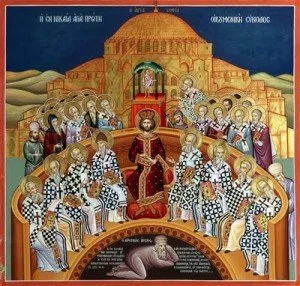
We present here three poems from Luis Cruz-Villalobos’ recent poetic work on the ancient creed from Nicaea which has now been translated into English, French and Romanian and is available under the title, Antipoems from the Nicene Creed.
On the term “antipoem,” we remember his broader term, antipoetry, which formed the basis of our first posts in this section of the site (featuring there Nonsensical Wisdom, Are Vampires Happy, Bloody Windmills, The 10 axioms of unhappiness, and Worldly Theorists). Antipoetry, as we might then briefly summarize it, represents a unique genre that seeks to elucidate philosophical and theological truth through a poetic examination of their opposite (The “anti-”).
As an example, The 10 Axioms of Unhappiness view the truths embedded in the Ten Commandments from the perspective of their contravention. Man can now break free from the divine laws given to order his life under the twin laws of love.
Now, instead of the restriction of the First Commandment,
You will have all the foreign gods that you crave
Now, instead of the Law of Sabbath rest,
You will work without rest like a beast
Now, instead of the injunction against lying,
You will lie and lie and lie that something will remain
Prof. Cruz-Villalobos delved deeper into the world of antipoetry in his subsequent poetic exegesis of the Beatitudes. And in these poetic laws that undergird true human happiness and human flourishing, Christ unveils what we might call anti-theological truths, extending divine blessedness to the most unlikely of men and women—those who are poor and mourning, those meek and hungry, those rejected and persecuted.
Prof. Cruz-Villalobos now turns his attention to the great 4th century Creed that has maintained unity in the churches of the East and West over the last millennia and a half.
The statement from the Creed is capitalized and in bold. The poetic exegesis follows below.
Enjoy!
And, as always, thank you Luis!
ALMIGHTY FATHER, CREATOR OF ALL THINGS
VISIBLE AND INVISIBLE...
Here the Nicene Creed, 1700 years old
Illuminates the path of our reasonable trust
It tells us not only that we believe in a reality thrice holy and
one
But also speaks of its character
He is not a tyrant
Not a warlike, despotic emperor
Still less a civil engineer with a pocket quantum computer
Nor a mad genius playing with dangerous materials
Even less a publicist or lawyer
Not the Wizard of Oz nor a supreme technological
singularity
Never a doctor seeking profit
Nor a CEO of a multinational pharmaceutical
No
He is simply a father
Now then
Think it through
I said a father
Not a manager
Not a general
But a father
This may sound very simple
But it is also profoundly beautiful
If we truly consider it
The creator and general director and sole shareholder of all
universes
From subatomic particles to galactic systems
Of all baryonic matter and energy, and all else that fills and
constitutes space
He
Is a father
That is
Someone to whom we are fundamentally bound, and who
loves us
With a love that transcends all circumstances and
conditions
Someone who awaits us with open arms and heart when we
return home
After having wandered the world, squandering his gifts like
foolish prodigals
A father
Not like our imperfect fathers
But a platonic one
An ideal father
Who corresponds to our deepest longing for a father
An essential father
An archetypal father
Full and perfect
And who cannot be contained in existence as one more
being
But who is the ontological ground of all beings
Pure aseity
And not only that
Also an omnipotent father
Pantokrator
That is
A sovereign father
Almighty
From whom nothing escapes
And over whom nothing has dominion
For he is the creator of all that can be observed and
measured and tested by scientific method
And of all we do not yet know exists, but whose presence is
truly effective
(as is the case with more than 80% of the matter and energy
of the universe, as noted above)
A creator who knows how everything works
And who, for that very reason, knows what we really need
And what are our maintenance requirements and the most
urgent inputs to avoid breakdown—momentary or
eternal.
WHO FOR US HUMANS AND FOR OUR SALVATION
CAME DOWN AND WAS INCARNATE, BECAME
HUMAN, SUFFERED AND ROSE ON THE THIRD DAY,
ASCENDED TO HEAVEN, AND WILL COME TO JUDGE
THE LIVING AND THE DEAD…
But he did not merely come here
He became one of us
He took on flesh with all its pain and troubles
He suffered in birth
In growing up
In sleeping and in dreaming
But especially in confronting the wisest and holiest of his time
Who condemned him to death for claiming to be one with the very heaven of heavens
For he suffered for the truth
That he spoke—and that he was
And he did not simply die
He was murdered
By blind powers who could not bear such light in their pupils
Yet even though he died the vilest, most savage death
At the hands of those who spoke of Pax and sustained it by
crosses and taxes
They could not defeat him
For he rose on the third day
And here we must pause drastically
Because remember
You cannot rise from the dead!
Death is the ultimate end
But here was someone who did exactly the impossible
And that confirmed that he was who he said he was
And not merely a dreamer
A fraud
Or a schizophrenic with megalomaniac delusions
No
He was the eternal Logos made flesh
God-with-us
Kissing us on the mouth
Just as he did with the Grand Inquisitor in Dostoevsky’s story
And for that reason
Because of that irrefutable factual argument called
resurrection
We know that just as he left
Full and smiling
Powerful and invincible
So one day he will return
But this time as judge of the living and the dead.
AND IN THE HOLY SPIRIT
And finally
As a perfect closure
Just as the Creed proclaimed that God is above us
As Father
And that he was among us
As Son
It also invites us to believe that God can be within us
As Spirit
For the Eternal gives not stingily
He pays all laborers the same
Because he cannot pay more
Because what he gives
Is not a figure
Not a sum
For he gives himself
Just as he gave himself in flesh and blood on the cross
At Pentecost he gave himself in Spirit
To all those who trusted in his name
Let us not forget that INRI spells YHWH in Hebrew
Oh, wondrous mystery revealed!
Love became flesh and gave itself on the cross
And conquered it in the resurrection
And then the Spirit
Chose to be born in the manger of the hearts of all who wait
For the return of the only King before whom we must bow
Amen.